In 2015 people aged 65 and over were the age group in Greece least burdened by housing costs; in 2025 they were the most burdened, at 31.8%, the highest share in the EU.
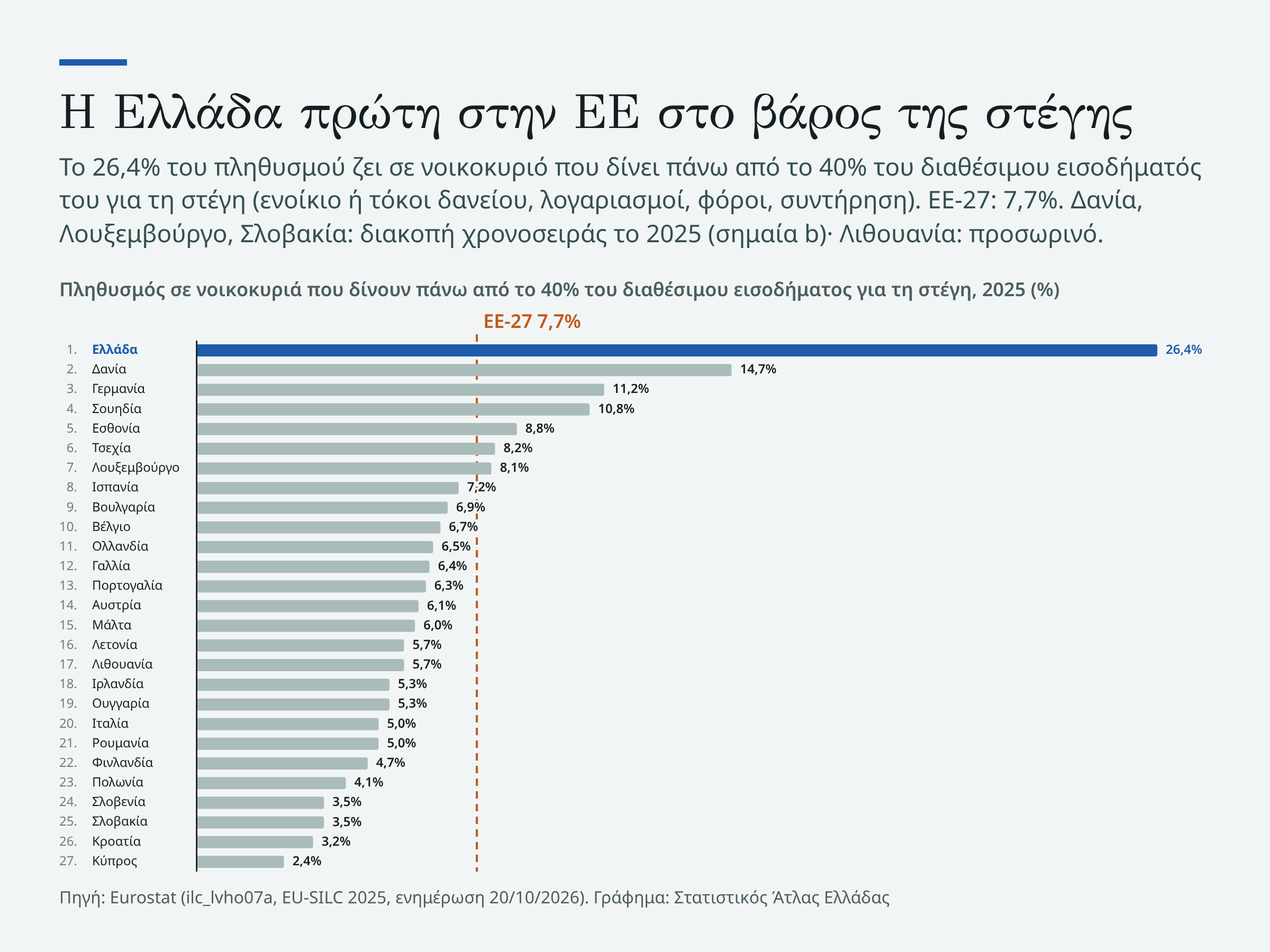
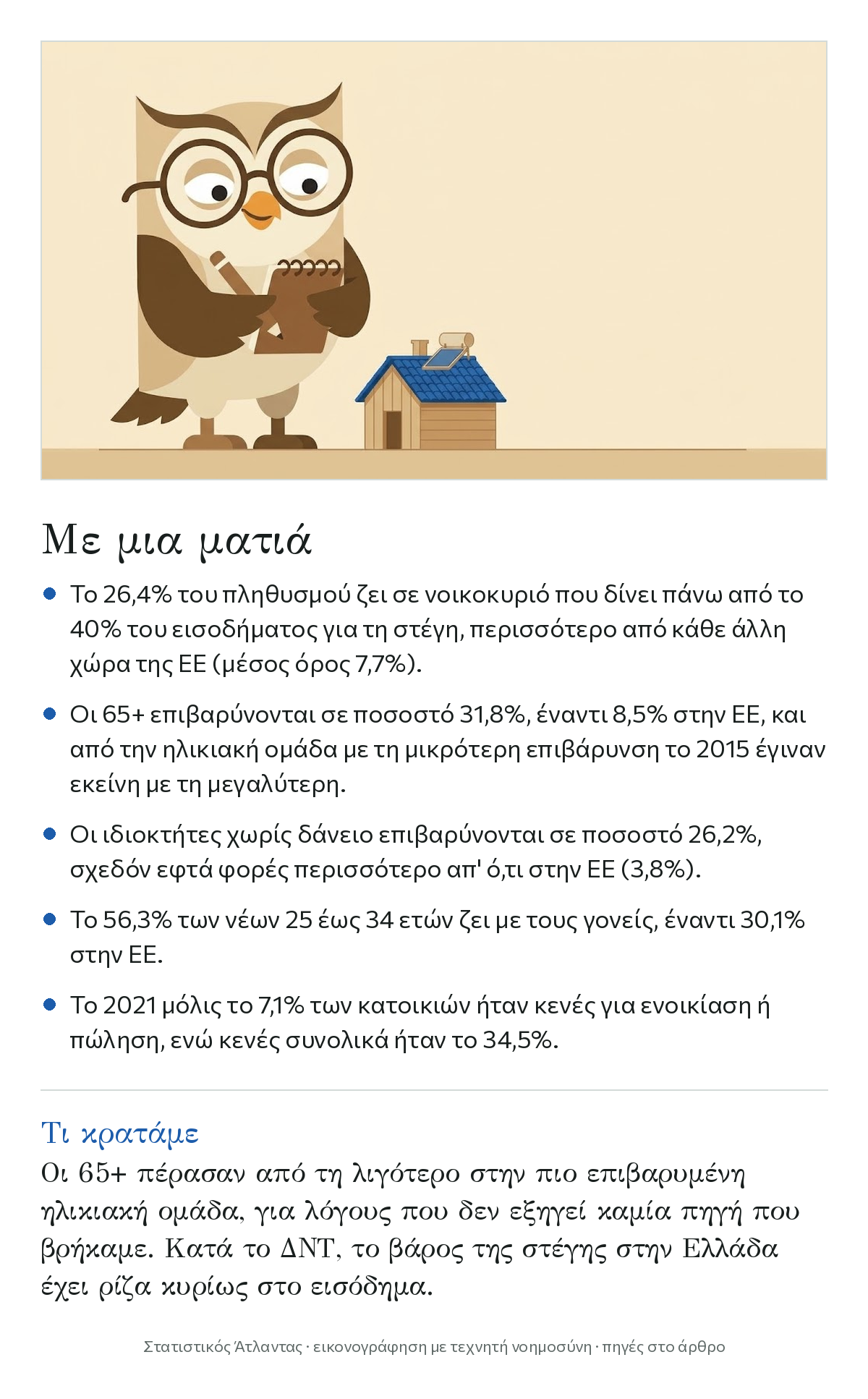
Almost one in three residents of Greece aged 65 and over lives in a household that spends more than 40% of its disposable income on housing. The share is 31.8%, and the comparison Eurostat published on 20 October shows that it is the highest in the EU, where the average for the same age group is 8.5%.
Ten years earlier the picture was the opposite. In 2015, of the three large age groups (under 18, 18 to 64, 65 and over), those aged 65+ had the smallest burden; in 2025 they had the largest. Over the same period the share for the whole population fell from 45.5% to 26.4%, while for those aged 65+ it stayed almost where it was, from 32.9% to 31.8%.
The overall 26.4% is also the highest in the EU, more than three times the European average of 7.7%. The second country, Denmark, had 14.7%, with a break in the series in 2025. Greece has been first every year since 2011, although the distance from the average narrowed after 2015.
Owners without a loan, but with bills
In Eurostat’s measure, housing cost is not only the rent or the interest on the mortgage, but also bills for water, electricity, gas and heating, taxes, charges, building insurance and maintenance.
In Greece the burden reaches even those who pay neither rent nor an instalment: 26.2% of owners without a loan are burdened, almost seven times the EU share (3.8%).
The IMF economists Tarak Jardak and Summer Cai, in a study on Greece published in July, write that the housing burden is rooted mainly in income. They note that the share of households that own property but have little current income has increased, and that many pay bills, maintenance and property taxes even without rent or an instalment. Greek homes are also energy-intensive: only 7.4% have an energy class of B or better.
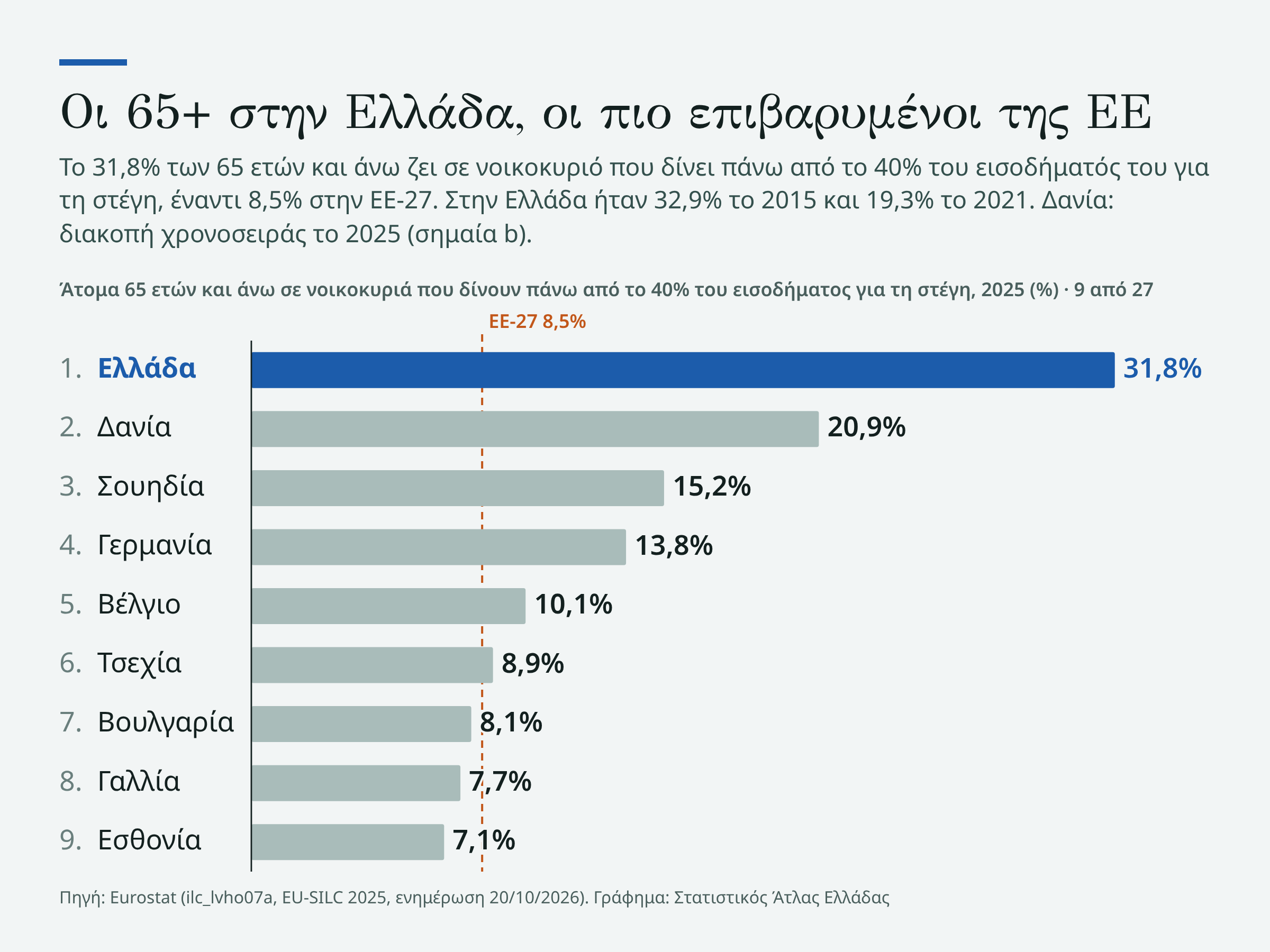
The pressure is greater on those who live alone: among those aged 65+ who live alone the share reaches 62.1%. And since 2021, when it was 19.3%, the share of those aged 65+ has been rising every year.
The burden falls on low incomes, and not only in Athens
The burden follows income like a ladder: in the poorest fifth of the population 82.1% are burdened, in the richest almost nobody (0.8%). And it is not only a matter for cities: in cities 26.9% of the population is burdened and in rural areas 26.4%.
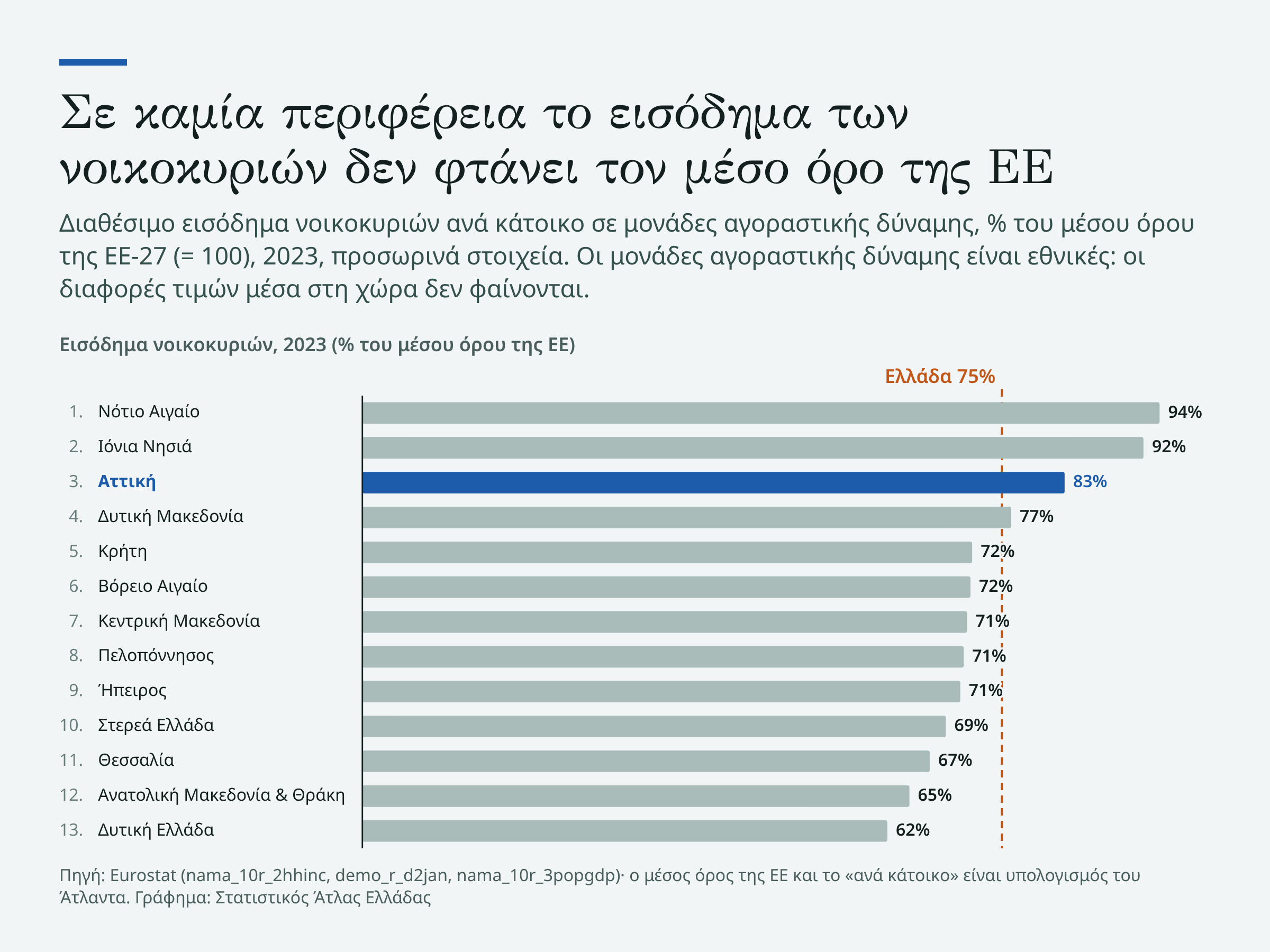
The atlas shows the other side, income, with a different measure. In 2023 household disposable income per inhabitant, in purchasing power standards, was in Greece 75% of the EU average. In none of the 13 regions did it reach the European average. Attica, third after the South Aegean and the Ionian Islands, was at 83%.
This is income for 2023, from the regional accounts. The 2025 burden measures income for 2024, from a household survey. This is why the two are placed side by side, not one as an explanation of the other.
In the parental home until 31
Among young people aged 15 to 29 the burden is 25.6%. And this is while most young people aged 25 to 34 still live with their parents: 56.3%, almost double the EU share (30.1%). On average they leave the parental home at 30.9 years. Eurostat notes this as an exception: in countries where young people leave late, such as Cyprus, Croatia and Italy, the burden is usually lower, while in Greece it stays high.
The same is visible in household composition. Adults living alone are 25.7% of Greek households, while in the EU more than one in three (37.5%). By contrast, 32.2% are households of «other type», with two adults who are not a couple or with more than two adults, more than one and a half times the EU share.
Households without dependent children are 73.8% in Greece, fewer than the EU average (76.6%). The Greek peculiarity is not homes without children, but the few adults who live alone and the many homes where adults live together.
Here housing meets the previous article on births. In 2025, 65,618 children were born in Greece, 44.5% fewer than in 2008, according to ELSTAT’s final data. According to the IMF, worse affordability keeps young people in the family for longer, and delayed independence affects fertility, which is already low. The IMF refers to a study that has not yet been published and does not give a magnitude. Our own data show only that slow departure from the parental home and fewer births coexist.
More expensive homes, fewer available than the census suggests
Meanwhile the market is rising: in the second quarter of 2026 apartment prices were at the highest point of the Bank of Greece index, 11.8% above the 2008 peak, in nominal terms. With inflation removed, they were still 19.8% below the 2007 peak. The IMF estimates that since 2016 prices have risen about 85%, while disposable income per inhabitant has risen 47%.
Rents in the Harmonised Index of Consumer Prices rose 10.0% in 2025, and in September 2026 were 5.9% more expensive than a year earlier.
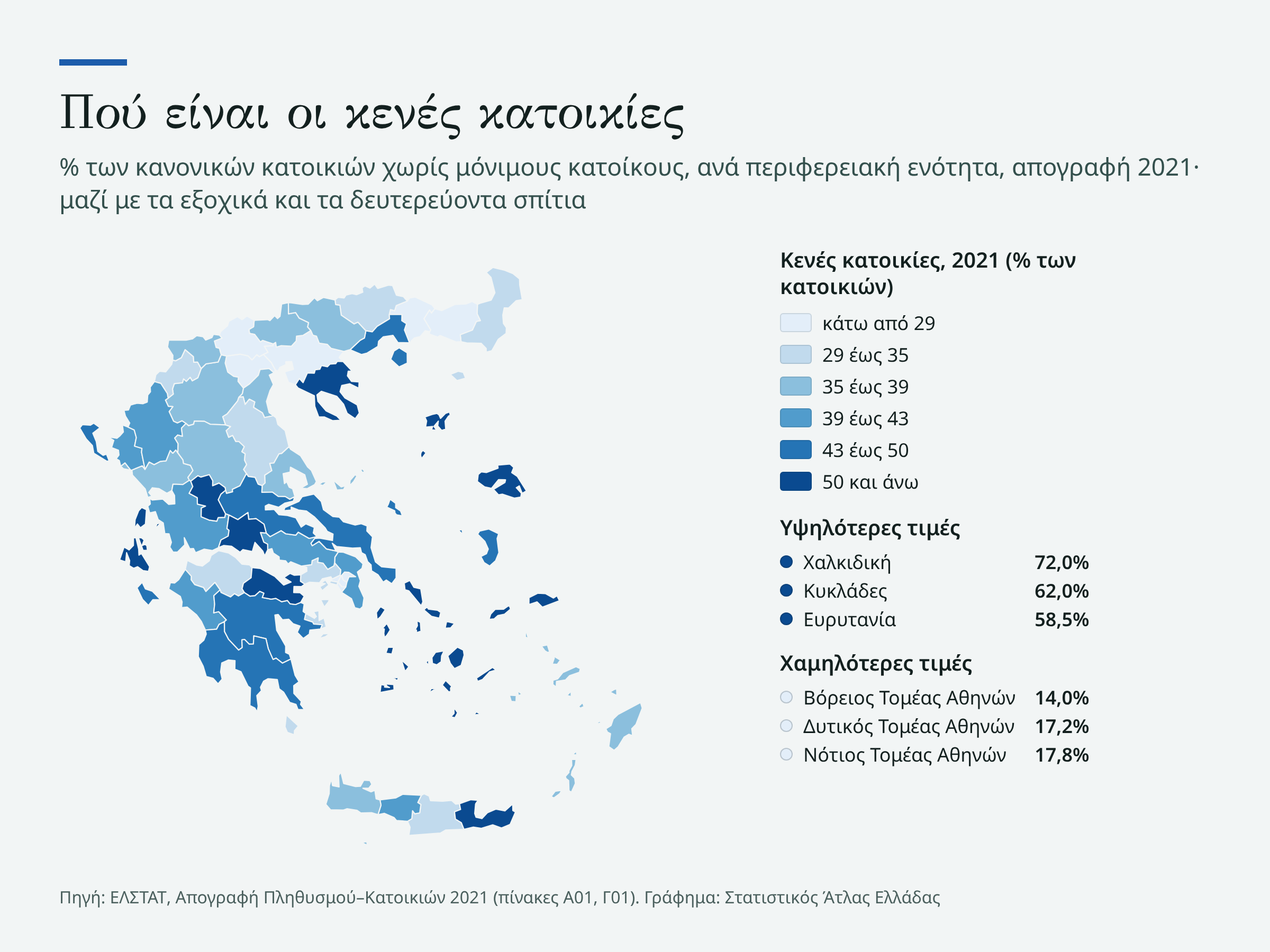
Homes do exist, however: the 2021 census counted 2,277,615 vacant dwellings, 34.5% of the total. «Vacant», though, does not mean available: of all dwellings, 13.0% were holiday homes, 9.5% secondary homes and only 7.1% vacant for rent or sale.
Differences from place to place are large. In Attica, the region with the lowest share, vacant dwellings were 28.7% in 2011 and 24.3% in 2021. The comparison is indicative, because in 2021 data collection was done differently, owing to the pandemic. Elsewhere the share is much higher: in Chalkidiki, together with Mount Athos, 72.0% of dwellings were vacant in 2021. In the Cyclades it was 62.0%.
Alongside these, short-term letting is growing: in Attica, overnight stays booked through platforms such as Airbnb and Booking rose 77.7% from 2022 to 2025, according to Eurostat. In hotels, rented rooms and campsites in Attica the increase was 24.1%. The two series are not added together, because according to Eurostat they overlap.
What the state is doing
The Ministry of Social Cohesion and Family, in its presentation of results in September 2026, counts more than 45 housing interventions with a budget of more than 6.5 billion euros. The largest programme by budget, «Spiti mou II» («My Home II») for a first home, approved 15,064 loans and, according to the ministry, «completes its life cycle».
In October 2025 the Minister of National Economy and Finance Kyriakos Pierrakakis had said on SKAI: «On 30 November we start with a rent refund for 80% of tenants». The 2025 rent refund ultimately reached 877,267 beneficiaries, and the housing allowance reached 481,264 from January to August 2026.
One programme is aimed specifically at older people, the housing assistance allowance for uninsured elderly, with 4 million euros for 2026, fully absorbed, and 557 beneficiaries from January to August. For the general programmes, such as the housing allowance and the rent refund, the presentation does not say how many beneficiaries are elderly. «Exoikonomo 2025», with a budget of 924 million euros and 37,829 beneficiaries, had not started its budget execution in September.
Among the measures announced at the 2026 Thessaloniki International Fair are the abolition of ENFIA from 2027 in settlements of up to 2,000 inhabitants, and up to 2,200 in Western Macedonia, for about 62,000 additional owners. They also include a transfer tax of 15%, up from 3%, for citizens of non-EU countries buying a home, and an extension for 2027 of the restriction on new short-term lets in the first three municipal districts of Athens and the first of Thessaloniki.
The IMF, which notes that the government already relies on renovation programmes and tax incentives, proposes combining them with disincentives for vacant homes and assessing how effective the restrictions on short-term letting are.
What we do not know
We did not find an analysis by ELSTAT or Eurostat explaining why the burden on those aged 65+ has risen since 2021.
In September 2026 the «Housing» group of the Consumer Price Index was 14.7% more expensive than a year earlier, with rents, electricity, gas and heating oil. The data from the 2025 survey, with income for 2024, do not yet contain these increases.
The series by housing tenure changes abruptly from 2021 to 2022, with no break flag: tenants at market price who are burdened fall from 74.6% to 37.9%. Until this is explained, we do not write a trend for tenants.
We do not know how many vacant dwellings can be inhabited: according to the IMF, more than half of the uninhabited ones were built before 1980. Nor how many were short-term lets in 2021, because the census tables do not show them separately. We did not find a published study that measures whether and how much housing affects births in Greece, nor a named source linking it to the emigration of young people.
One thing, however, is clearly visible. Housing is not only a problem for those looking for a home, but also for those who have a home and a small income.
How we measured it
The burden is the share of persons, not households, living in a household where housing cost exceeds 40% of disposable income, both «net» of housing allowances according to Eurostat. The IMF notes that these data need caution: incomes may be reported lower, especially those of the self-employed, richer households respond less, and part of the housing cost is estimated. For Greece the series by age has no break flag from 2010 to 2025. 2021 was a low year for those aged 65+, since in 2019 their share was 27.6%, which is why the article’s central comparison is made with 2015.
The household shares are our own calculation from the Eurostat table. «Child» is, according to Eurostat’s article on household composition, a household member under 18; the table, however, counts households with «dependent children», which in the survey methodology go up to 24. Young people «with their parents» also include students who study away but live on the family’s income. The rent index did not change at all from January 2018 to April 2021, which is why we compare rents only from 2022.
Household income by region is an atlas indicator: the «per inhabitant» figure and the EU average are calculated by us from the Eurostat tables, and the 2023 data are provisional. Purchasing power standards correct for price differences between countries. For regions, national units are used, so the more expensive areas of a country appear richer than they are.
The shares of vacant dwellings are our own calculation from ELSTAT’s tables, where conventional dwellings are divided into occupied and vacant, and among the vacant, holiday homes and secondary homes also count. The 2011 and 2021 tables have the same dwelling categories, but the 2021 questionnaire differs and, owing to the pandemic, collection was done mainly by electronic self-enumeration instead of an interview with a paper questionnaire; this is why we treat the comparison of the two censuses as indicative.
Sources: Eurostat, ELSTAT, IMF, Bank for International Settlements, Ministry of Social Cohesion and Family.