Life expectancy is slightly above the EU average, yet one in five Greeks who needed a doctor in 2025 did not get the care they wanted, mostly because of cost.
Of five Greeks who needed a doctor in 2025, one said he did not get the care he needed because it was too expensive, too far away or had a waiting list. In the EU-27 the ratio is about one in 28. At the same time, a person in Greece lives 81.9 years on average, slightly above the EU average (81.5). The two pictures do not contradict each other, but neither explains the other.
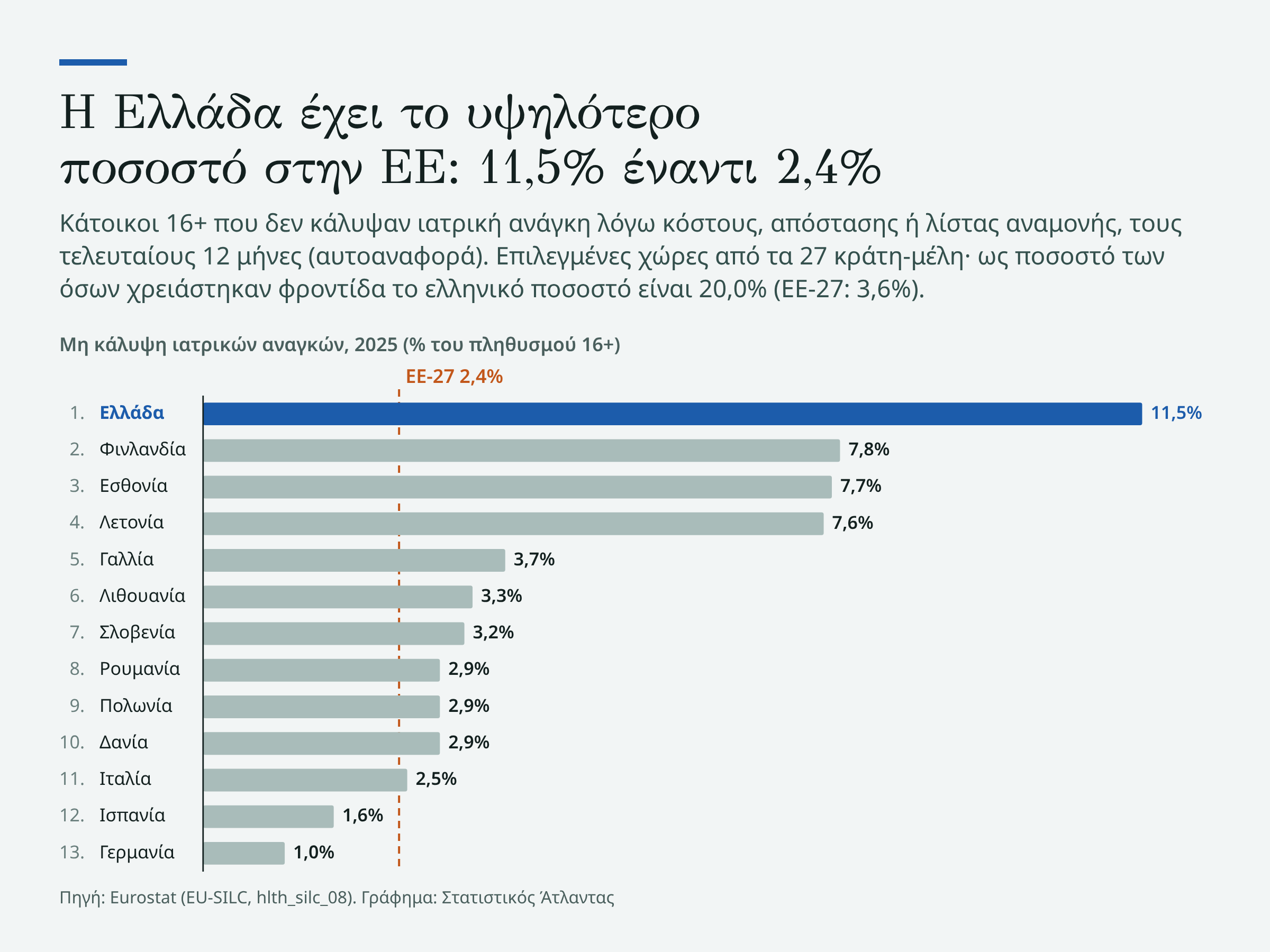
Greece is first in the EU for unmet medical needs
Every year Eurostat asks a sample of residents whether they missed medical care in the previous 12 months. Greece produces two numbers, depending on whom you count. As a share of all residents over 16, it is 11.5% against 2.4% in the EU-27, the highest in the Union. Next comes Finland with 7.8%. As a share of only those who needed a doctor, it is 20.0% against 3.6%. It is the same phenomenon with two denominators, and they should not be read together: from here on, unless stated otherwise, we mean the first.
The weight falls on cost. Because it was too expensive alone, 8.8% of residents went without (EU-27: 1.0%). The waiting list alone accounts for 2.0%, against 1.2% in the EU.
The bill lands in the pocket
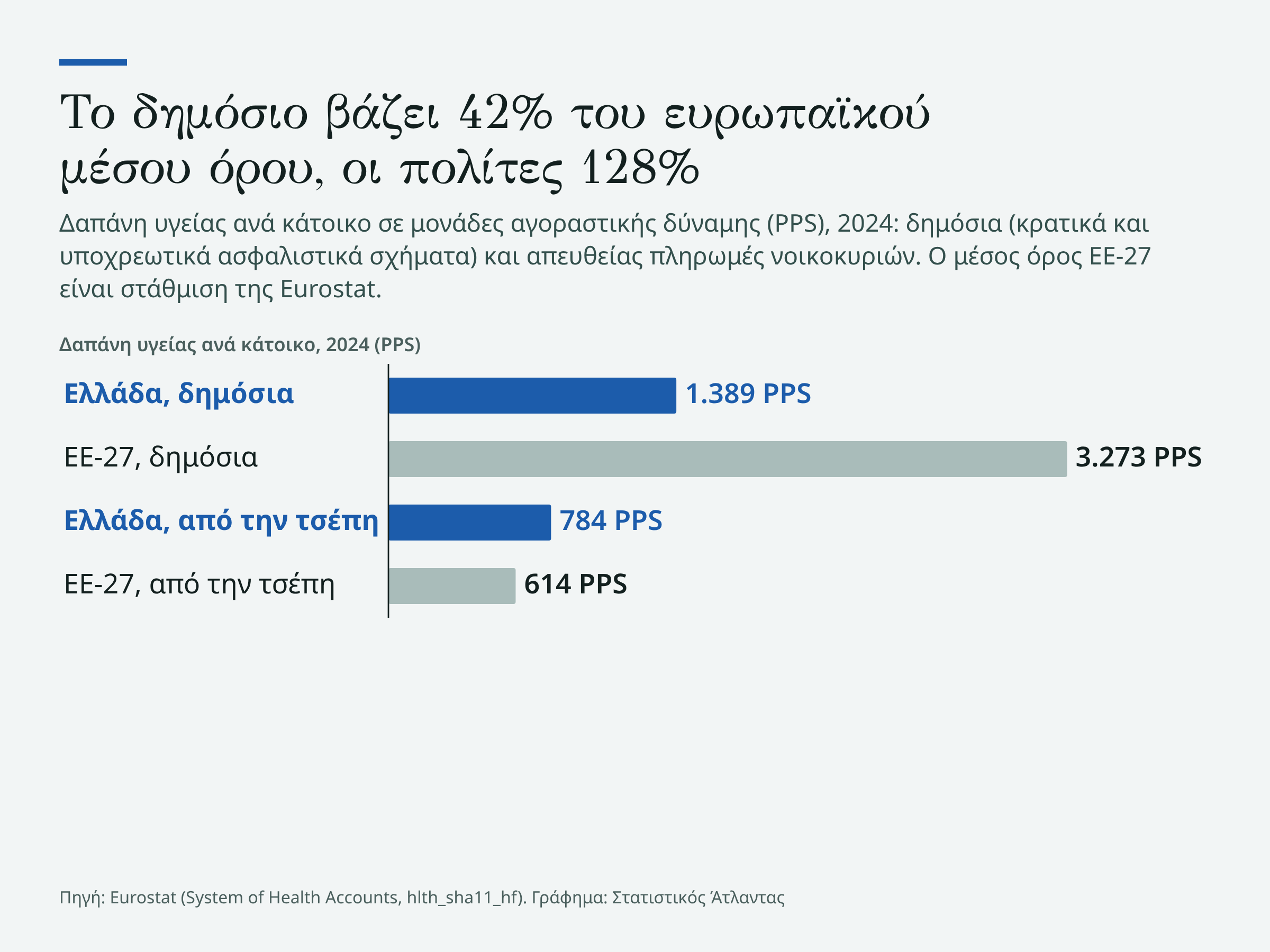
Of every 100 euros spent on health in Greece, 34.2 are paid directly by households out of pocket. In the EU-27 it is 15.1. Bulgaria is at the top too (34.1%), so Greece is not alone.
The public sector spends 5.1% of GDP on health, against 8.2% in the EU. Because Greece’s GDP is lower, spending per resident in purchasing power standards (PPS) is a cleaner measure. There the public sector puts in 1,389 PPS against 3,273 in the EU, or 42%. Out-of-pocket payments are 784 PPS against 614, 28% higher.
The 2025 report by the OECD, the European Observatory and the Commission adds two details: medicines were 27% of health spending in 2023 (13% in the EU) and dental care has in practice been paid out of pocket since 2011.
We live as long as the others, but that proves nothing
Life expectancy at birth is 81.9 years, about 15th among the 27, behind Spain (84.0) and Italy (83.7). At 65 the gap almost disappears: 20.3 years against 20.2.
It would be convenient to say “so the system works”. It would be the same mistake to say the opposite. Life expectancy depends on diet, climate, smoking and much else, and it is an average over a whole life: it does not show who went without a doctor this year. Nor do hospital beds set Greece apart: 423 per 100,000 residents, almost the same as a decade ago (425 in 2014). That is below the EU average (507) but above Spain (284) and Italy (312). Beds, of course, do not measure staff or quality.
Those with less are left behind
The gap is not shared equally. Of those living below the poverty line who needed a doctor, 30.3% did not get the care they needed (EU-27: 5.9%). In dental care the corresponding share of the population aged 16+ is 11.5% against 3.3%; it coincides with the 11.5% of the first indicator, but it is a different indicator.
From the 2021 low the rate rose: 6.4% in 2021, 9.0% in 2022, 11.6% in 2023, 12.1% in 2024, 11.5% in 2025. These are not unknown levels: in 2016 it was 13.1%. The survey is sample-based, so the 0.6-point fall in 2025 is not enough to speak of a change of course. What is certain is that the rate is 5.1 points above 2021.

What the other side says
The government is moving. Since 2024 afternoon surgeries have run in public hospitals, the first 37,500 of them free, alongside the personal doctor, with automatic enrolment of unregistered adults from 1 June 2025. General practitioners per 1,000 residents doubled, from 0.19 in 2010 to 0.38 in 2023. Public spending per resident rose 35% from 2019 to 2024, against 33% in the EU, and the gap remains large. The Commission and OECD report records that doctors’ unions point out that the afternoon surgeries do not solve the shortage of anaesthetists and nurses, and that wealthier patients can be seen faster.
The 2025 indicators do not yet show a clear improvement: unmet need is 11.5%, above the 6.4% of 2021. Whether it will, we do not know.
One number is missing from every life-expectancy statistic: the patient who did not go to the doctor. Until we find him in the figures, the picture of health stays half-drawn.