


Almost one in five people in Greece could not keep their home adequately warm in 2025, the highest share in the EU. On heating, the gap with Europe did not widen during the energy crisis, and electricity, in euros, is not dearer than in the EU; for the poorest households, however, the gap in unpaid bills did widen. Institutions criticise how the support was targeted, and no outcome has been announced of the authorities’ investigations into the wholesale market.
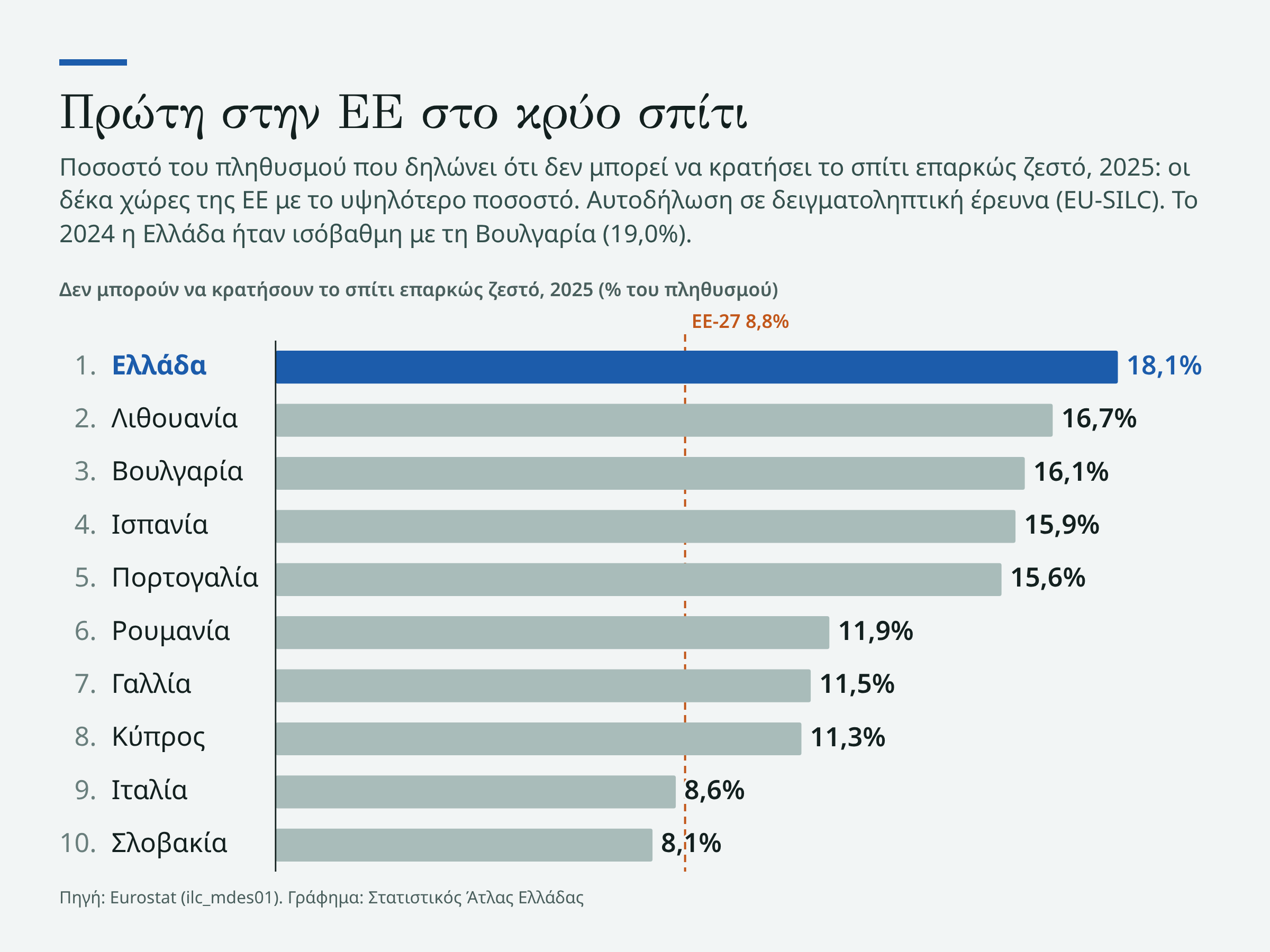
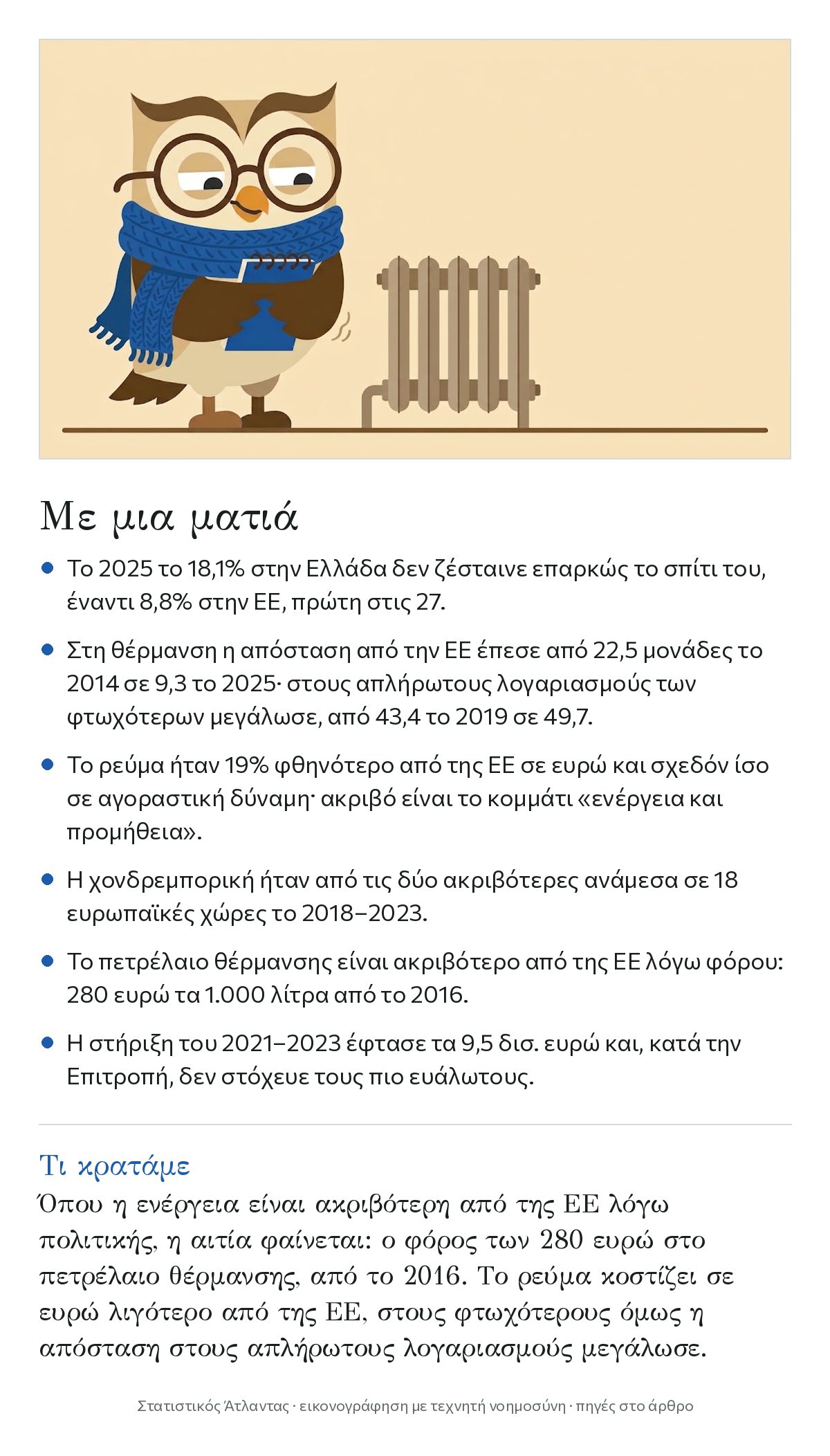
In 2025, 18.1% of people in Greece said they could not keep their home adequately warm, against 8.8% in the EU: first place among the 27, ahead of Lithuania (16.7%). 31.9% lived in a household that had fallen behind on electricity, water or other utility bills, against 7.0% in the EU; on that measure Greece has ranked first every year since 2012.
We tested three suspicions: that the situation worsened with the crisis, that energy became dearer because of policy handling, and that suppliers move together. The yardstick is the EU in the same year, because the 2021–2023 crisis was European.
First in the cold, but closer to the EU than in 2014
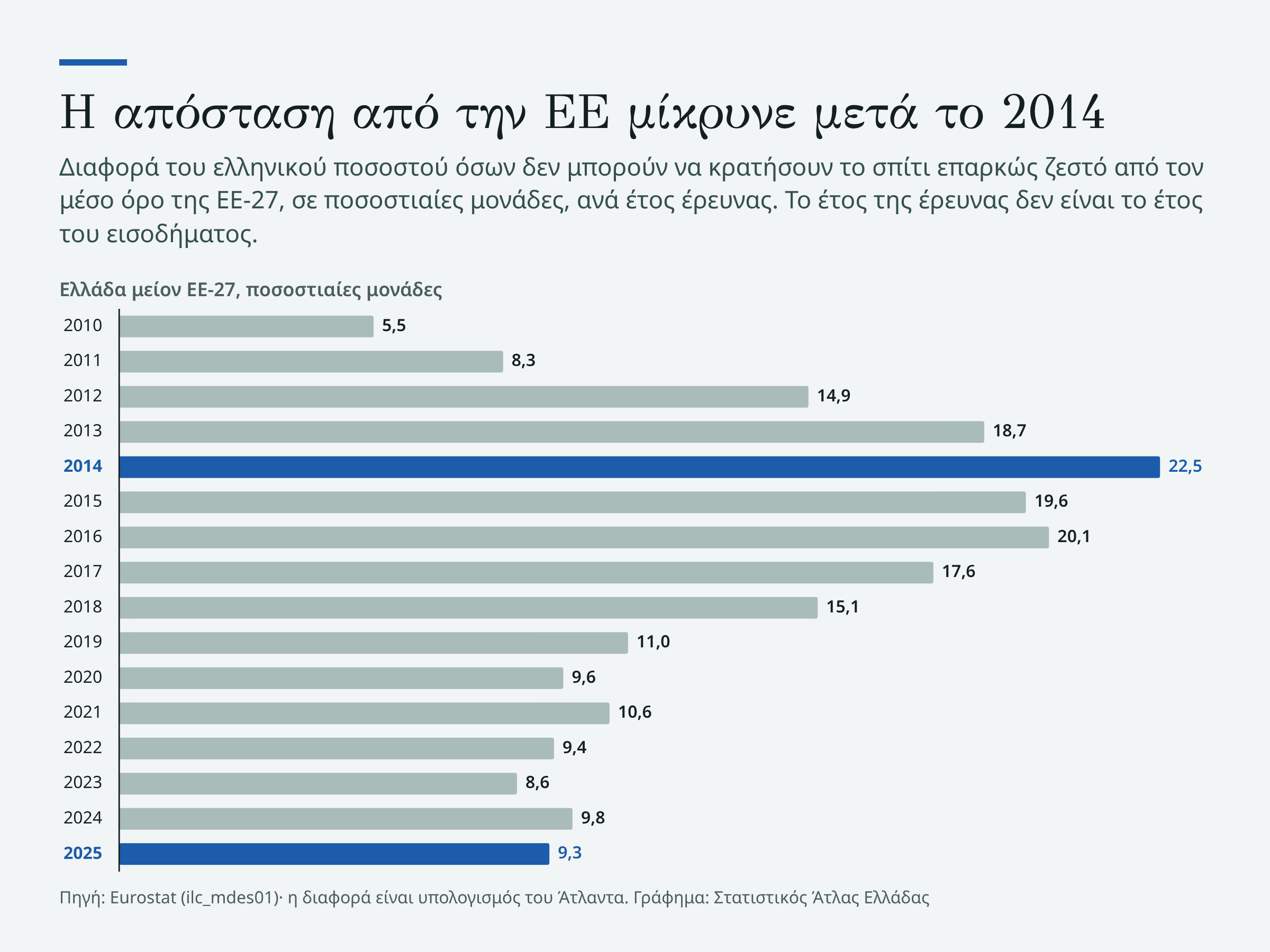
On heating, the gap with the EU narrowed. In 2014 the Greek share was 22.5 points above the EU’s, in 2019 11.0 and in 2025 9.3. From 2019 to 2023, at the heart of the crisis, it rose 1.3 points in Greece and 3.7 in the EU. Others, however, improved: from 2019 to 2025 Bulgaria fell 14.0 points, while Greece stayed almost where it was.
For the poorest the picture is different. Among households with income below 60% of the median, 66.5% had fallen behind on bills in 2025, against 16.8% in the EU. Here the gap widened: from 43.4 points in 2019 to 49.7 in 2025. Electricity disconnection orders sent by suppliers to the distribution operator (DEDDIE) rose from 370,980 in 2022 to 627,148 in 2023, and 327,161 were carried out. The table does not separate households from businesses or give reasons.
The home matters too: 9.5% of people lived in a dwelling with an energy improvement in the last five years, against 23.9% in the EU. Weather does not explain the map: Western Greece, with 1,237 heating degree days in 2025, had the highest share, 30.4%, and much colder Thessaly, with 1,662, the lowest, 10.8%.
Electricity: cheaper in euros, except for one component
For a typical household, using 2,500 to 4,999 kWh a year, electricity cost 0.234 euros per kWh in 2025 with all taxes, 19% less than the EU average (0.289). In euros the Greek price was below the EU’s in every period: on average 18.5% in 2015–2018, 25.1% in 2019–2020, 17.9% in the 2021–2023 crisis, the smallest gap, and 20.4% in 2024–2025.
In purchasing power standards, which adjust for a country’s price level but not for incomes, the picture changes. Greece was 12% below the EU in 2019 and 0.3% below in 2025, and was above the EU in 2022 (4.4%) and in the second half of 2025 (0.8%).
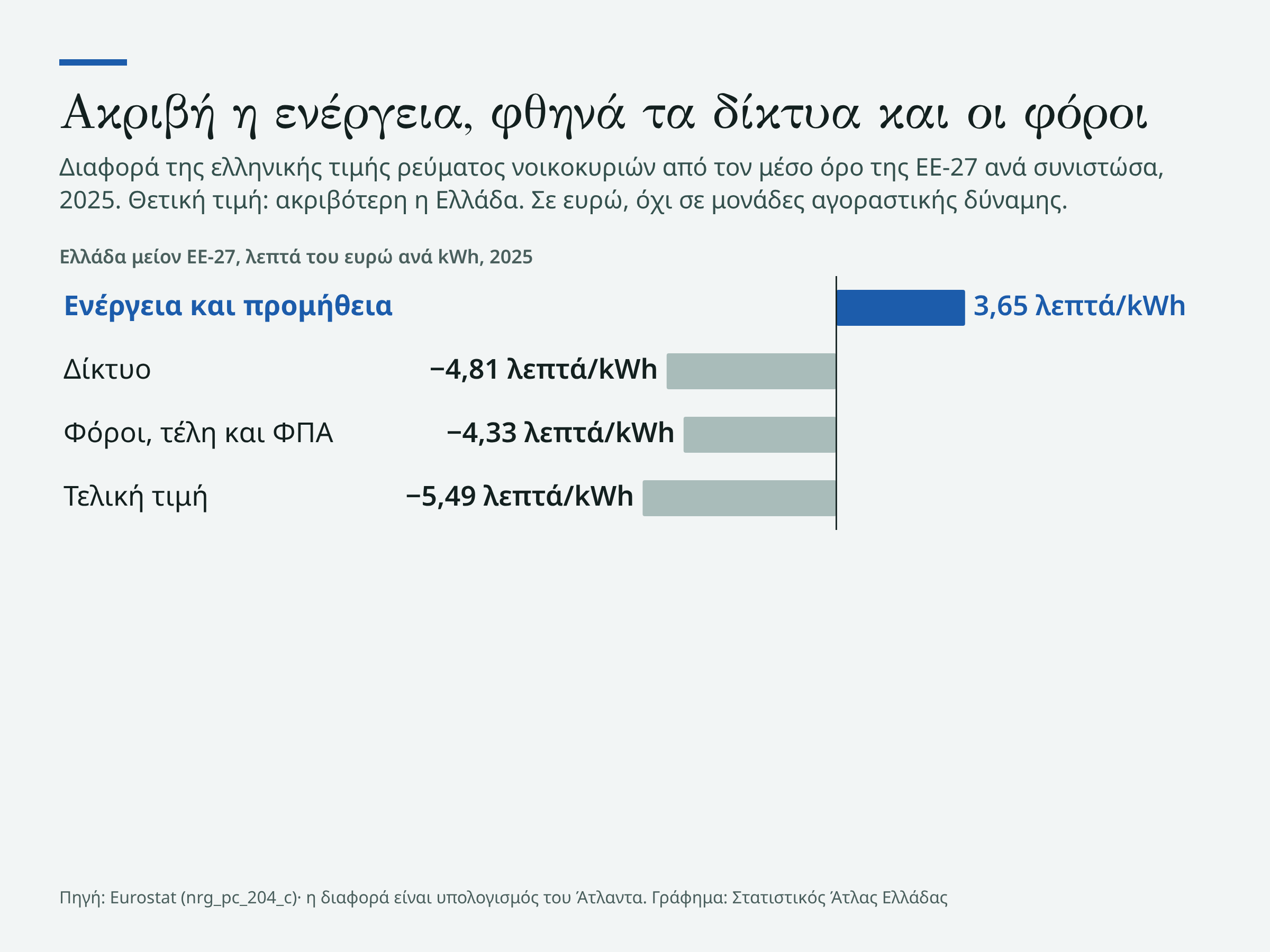
The expensive component is the energy itself. «Energy and supply» was 0.161 euros per kWh in Greece and 0.125 in the EU, the third highest of the 27. The network component was 59% cheaper, and taxes and levies together with VAT came to roughly half of the EU’s.
Wholesale: at the top until 2023
Among 18 European countries, Greece’s average price was the highest or second highest every year from 2018 to 2023. In 2019 it was 36% above their median.
ACER attributed the 2019 rise to a 33% fall in hydropower output due to drought. The OECD writes that prices in 2021–2022 were among the highest in Europe «mainly» because of heavy dependence on natural gas. The European Commission, for 2024, cites gas, the «structural lack of flexible solutions» and less water. These are the causes given by the three institutions; we did not read the IMF or the Bank of Greece.
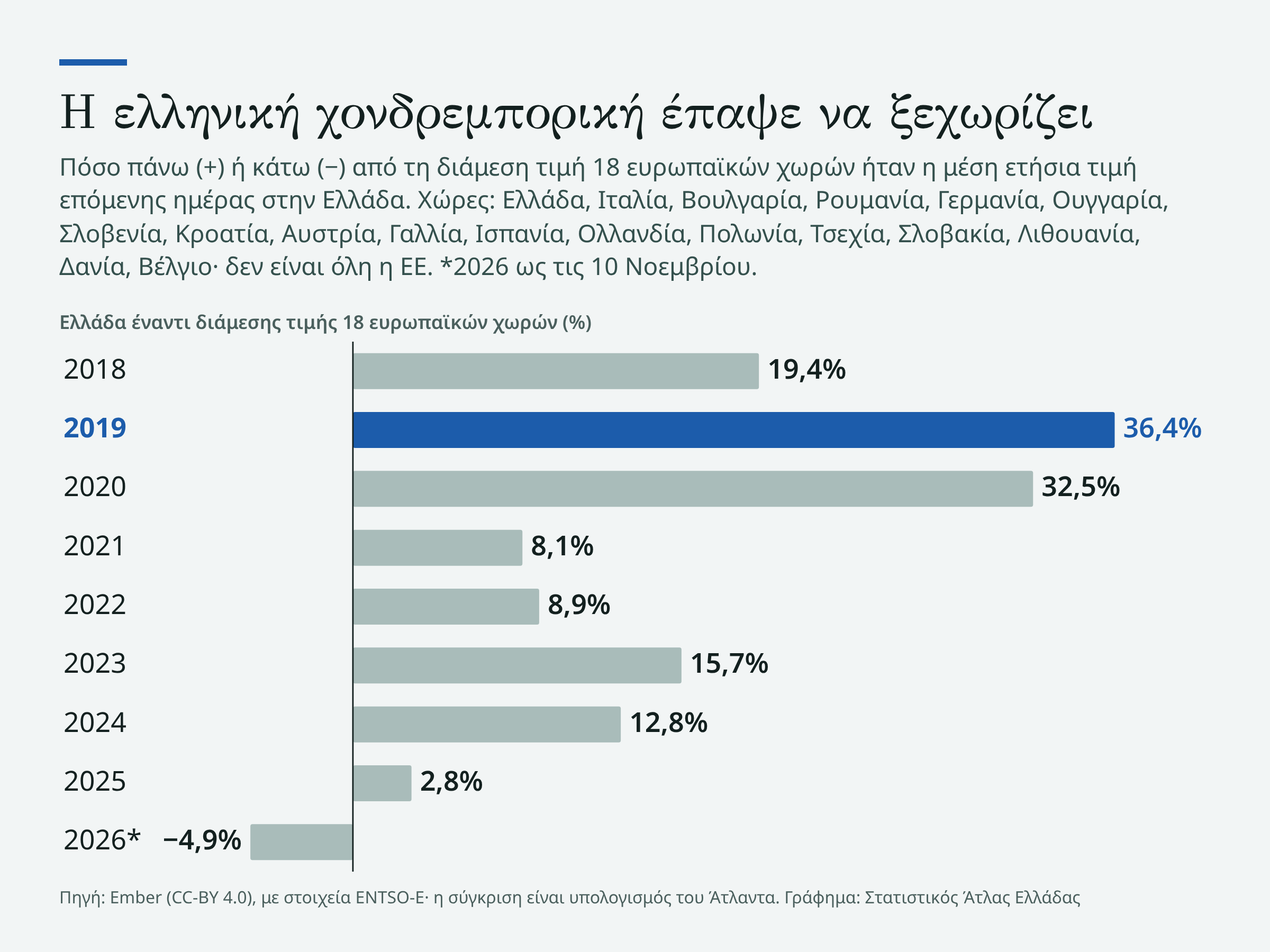
Since 2024 the gap with Bulgaria, Romania and Hungary has disappeared. In 2026, to 10 November, Greece ranked 11th of the 18 countries and was 10% cheaper than Bulgaria. That does not mean cheap electricity: in October the average wholesale price was 197 euros per megawatt-hour, and in the first 11 days of November 284, the highest since September 2022.
The tax that makes oil dear
For heating oil the cause is written into law. In the 2025 heating weeks, before taxes, it cost in Greece almost as much as in the EU, 670 against 688 euros per 1,000 litres. With taxes, 1,193 against 1,042. The excise duty on heating oil, in force from 15 October to 30 April, has been 280 euros per 1,000 litres since 2016, while the EU minimum is 21, and 24% VAT is added on top.
Until October 2011 the duty was 21 euros, then 60, and in October 2012 it became 330, equal to that on diesel. Finance Minister Yannis Stournaras then said the equalisation was made «to tackle smuggling». From 2011 to 2013 the quantities of heating oil sold on the market fell 66%; the statistical authority gives no cause. They did not recover: in 2024 they were 71% below 2011, on provisional data.
The duty fell to 230 in 2014 and rose to 280 in 2016, an increase that, according to the Finance Ministry, was foreseen in the agreement with the lenders and was a «necessity and not a policy choice». It has stayed the same since. In October 2026 support was given at the pump, not by cutting the tax: 20 cents per litre from the state and a 20-cent discount from the refineries. The state subsidy was extended at the same level to 15 November, and the 2025 prices with taxes do not include it.
A lot of support money, with wide targeting
In Bruegel’s data, Greece announced measures of 9.5 billion euros from September 2021 to January 2023. In 2022 the price of electricity before taxes was the highest in the EU, but the final price in euros, after subsidies, was 14% below the EU’s.
The institutions’ criticism concerns targeting. In Bruegel’s data, 74% of the measures were an electricity subsidy for everyone, and only 17.6% of the support to households was targeted. The Commission wrote in 2023 that most measures do not target the most vulnerable. The OECD wrote that thresholds were so broad that practically all households qualified, except the highest incomes with high consumption.
The government, in the 2024 draft budget, writes that the 2023 measures were funded mainly by the Energy Transition Fund and by an extraordinary levy on fossil-fuel companies, and estimates the net fiscal result as «balanced». The Council of State held the 90% levy on the windfall revenues of electricity producers to be constitutional. The Commission records that the country fully implemented the recommendation to withdraw the emergency measures, and that from August 2022 to January 2023 gas and electricity consumption fell more than the EU average.
For winter 2026–27 the government announced a 30% increase in the heating allowance, with an estimated budget rising from 173 to 225 million euros and the same criteria.
Suppliers: concentration and investigations
In 2025 PPC (DEH) had 50.3% of consumption and 70.9% of meters, and the HHI concentration index was 3,071, in the band that ACER and European regulators call «high concentration». PPC’s share is falling: in low voltage it was 75–85% in 2018 and 55–65% in 2022, according to the Competition Commission.
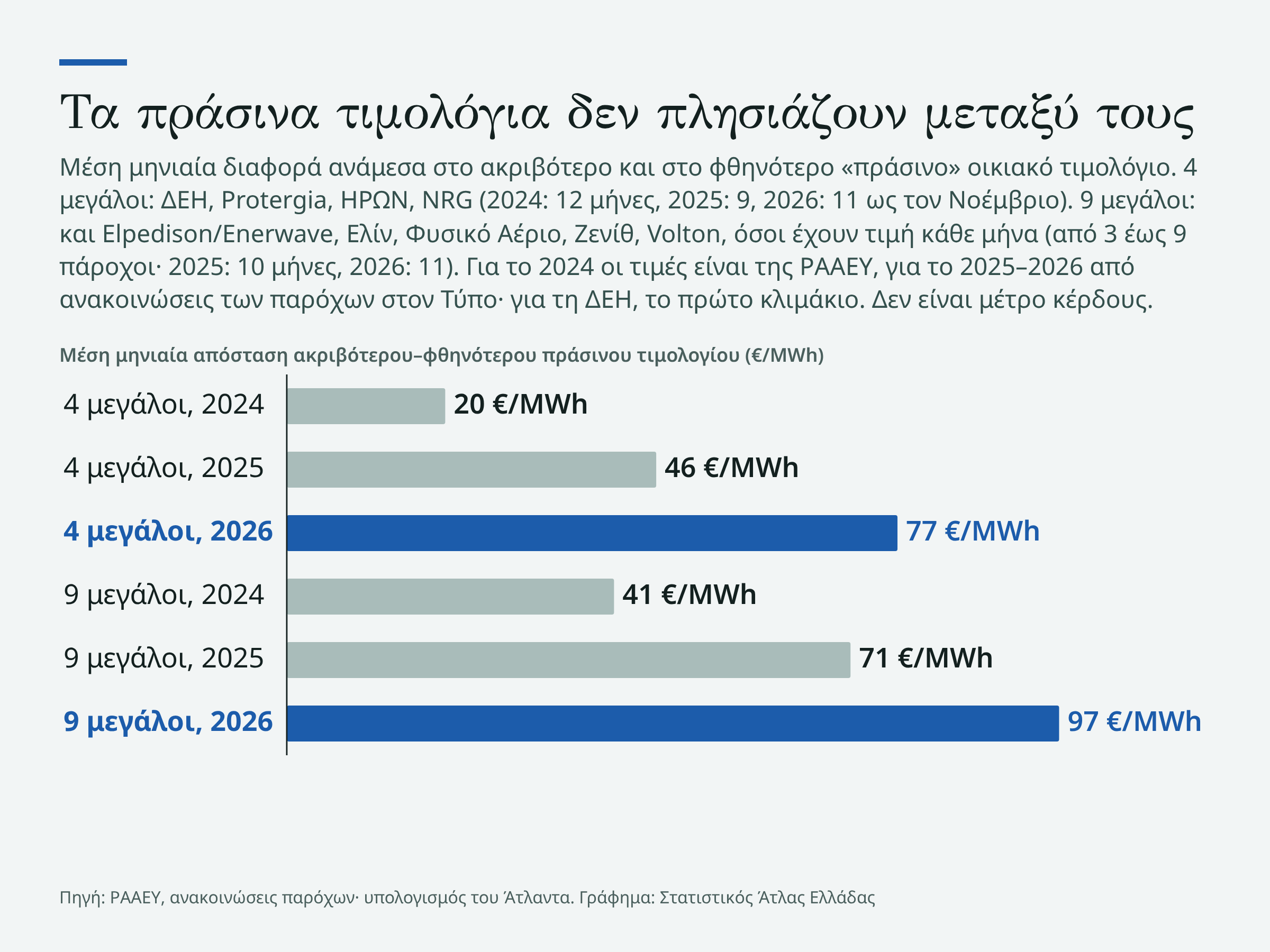
That «green» tariffs rise and fall together is not in itself a sign of coordination. The ministerial decision’s formula provides for it, containing the previous month’s wholesale price; in 2024 the prices of the 13 suppliers had a correlation of 0.69 to 0.97 with it. Their prices, though, do not converge. Among PPC, Protergia, HRON and NRG, the average monthly gap between the cheapest and the dearest «green» tariff was 20 euros per megawatt-hour in 2024, 46 in 2025 (nine months of data) and 77 in 2026 (eleven months), by our own analysis of data from the energy regulator (RAAEY) and supplier announcements. Nor did «rockets and feathers» show up: after a rise in wholesale prices tariffs followed by 0.88 of the change and after a fall by 1.17, a difference that is not statistically significant in a small sample.
The authorities have dealt with prices. In 2021 the energy regulator (then RAE) found, in decision 521, that one supplier had breached its obligations to inform customers and to apply the adjustment clause correctly; it stopped at a recommendation, reserving sanctions. ACER, analysing summer 2024, found that bidding in the wholesale market changes when the market is «tight» and proposed that the authorities examine whether abuse occurred, such as capacity withholding. In December 2025 the Competition Commission carried out unannounced inspections at generation and wholesale companies, and the regulator opened its own investigation; as of 13 November no outcome has been announced.
The European Commission sent PPC a statement of objections in 2024 for 2013–2019. The Commission’s preliminary view is that PPC sold lignite- and gas-fired electricity on the wholesale market below variable cost; the objections do not prejudge the outcome. PPC replies that this is a period before the redesign of the market; as of 13 November no decision has been announced.
How we measured it
The shares for heating and bills are self-reported in the Survey on Income and Living Conditions, which is sample-based. In 2022–2023 subsidies enter Eurostat’s prices as a negative tax. The 18 countries of the wholesale comparison are not the whole EU. The gap between tariffs is our own calculation, not a measure of profit.
Sources
Eurostat · ELSTAT · European Commission · ACER and CEER · OECD · Bruegel · RAAEY (formerly RAE) · Hellenic Competition Commission · Council of State · Ember (ENTSO-E data) · Ministry of National Economy and Finance · PPC

