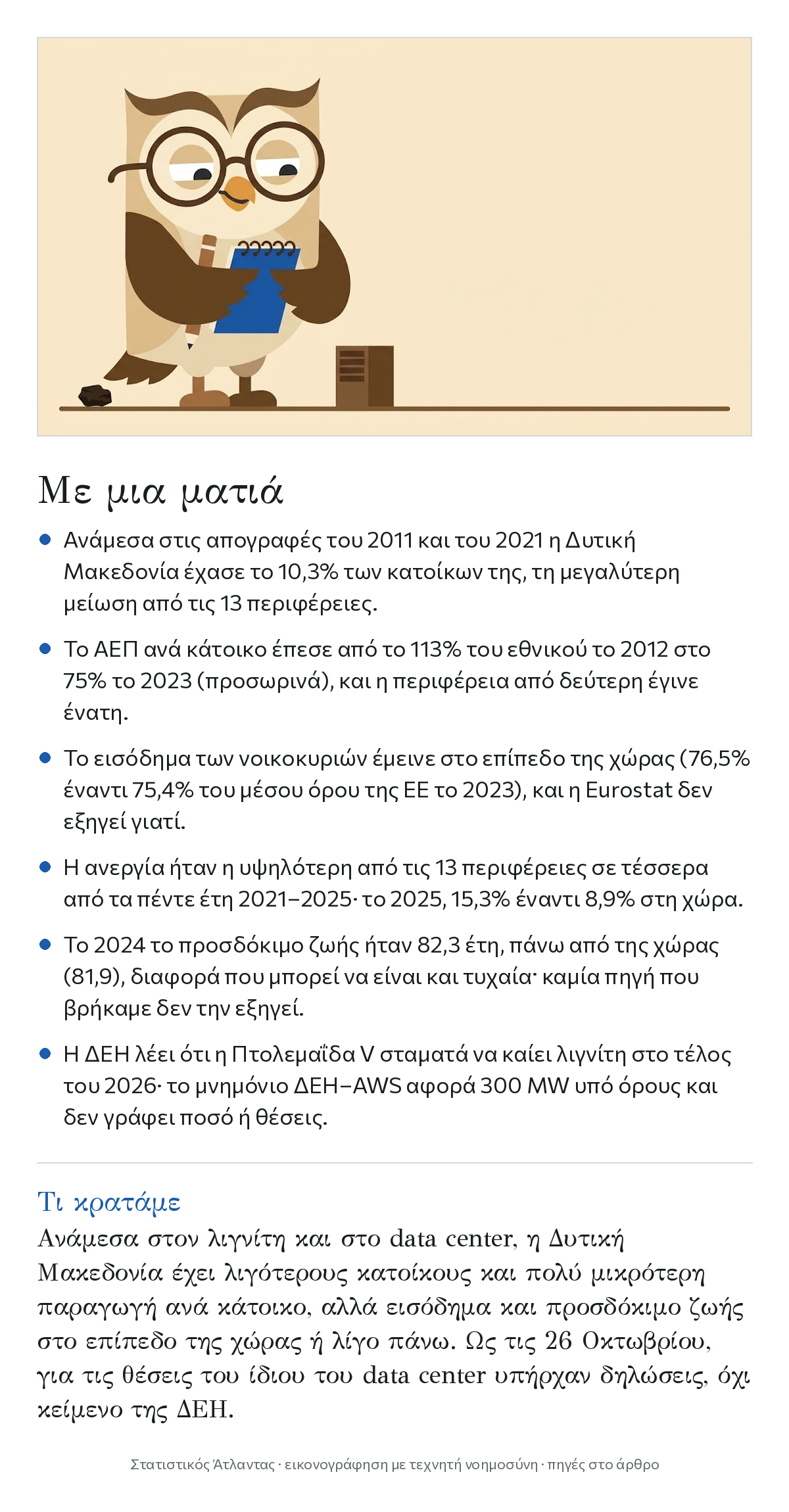
PPC says Ptolemaida V stops burning lignite at the end of 2026, and its announcement of the data centre it plans at Agios Dimitrios states neither an amount nor a number of jobs. The region between them lost 10.3% of its residents from 2011 to 2021 and GDP per capita fell from 113% to 75% of the national level from 2012 to 2023, while household income stayed at the national level.
At the Agios Dimitrios steam power station, outside Kozani, 420 people were working at the start of 2026 and 58 in September, according to PPC, as reported by Bloomberg. Lignite has not gone out completely: PPC told energymag on 29 September that Ptolemaida V «will stop burning lignite by the end of the year». According to press reports, the Regulatory Authority for Waste, Energy and Water keeps it available as a reserve until 31 March 2027; we did not find the decision published.
At Agios Dimitrios PPC plans a data centre with a supply capacity of 300 MW in the initial phase and a possible expansion to 1 GW. On 17 September it announced a memorandum with Amazon Web Services for a 15-year lease, if final agreements are concluded, without stating an amount or jobs. «They will have to explain to us exactly what kind of Data Center it will be, and how many jobs and what kind of staff we are talking about», said the mayor of Kozani Giannis Kokkaliaris, according to a report by Chronos Kozanis of 29 September.
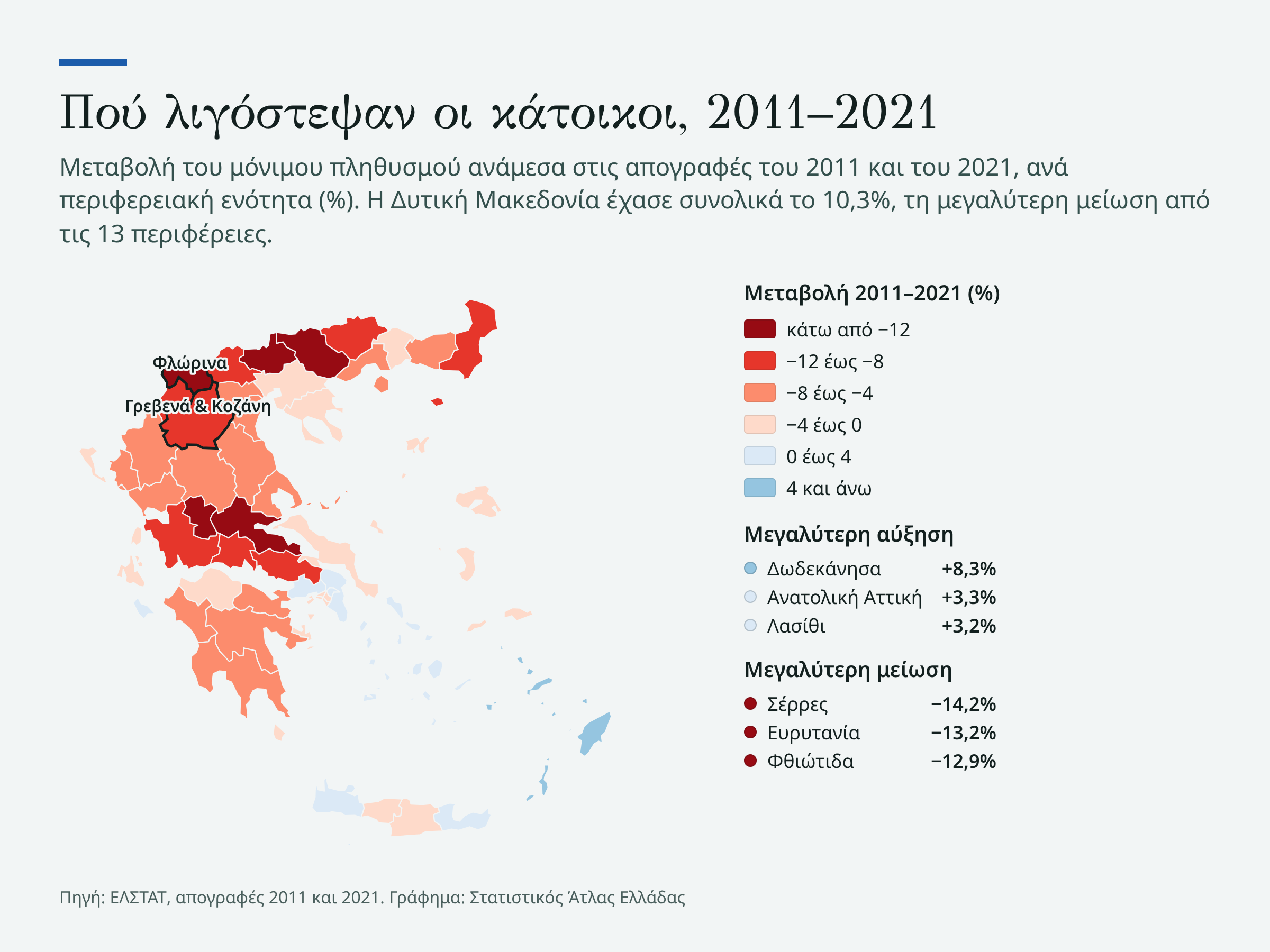
The region around them is emptying: between the 2011 and 2021 censuses it lost 10.3% of its residents, the largest decrease of the 13 regions, when the country lost 3.1%. GDP per capita fell from 113% of the national level in 2012 to 75% in 2023, and from the country’s second region it became ninth. Household income, however, stayed at the national level, and life expectancy is slightly above that of the country.
This article does not measure the investment, but the area between the two, with figures from different sources, none of which explains the other.
Fewer, older, with fewer children
In the 2021 census Western Macedonia had 254,594 permanent residents, from 283,689 ten years earlier. Florina lost 12.7% of its residents, the fourth-largest decrease among the country’s regional units. The annual estimates show that the decrease continued: from 1 January 2022 to 1 January 2025 the region lost another 4.1% of its population, again more than any other, when the country lost 0.9%.
Births halved: in 2008, 2,696 children were born to mothers living in Western Macedonia and in 2024 only 1,293. That is a decrease of 52.0%, the largest of the 13 regions. In 2025, according to ELSTAT’s final data, 1,294 children were born, one more, while in the country births decreased; one birth, however, does not make a trend.
Since 2001, when deaths exceeded births by 190, more people die in the region every year than are born. In 2024 the natural change was negative in all regions, but in Western Macedonia it was the lowest: −8.4 per thousand residents, against −5.6 in the country.
Bloomberg writes that young people are leaving the area en masse. How many left, however, is not measured directly: from 1 January 2022 to 1 January 2025 the population fell by 10,300 people, of whom about two in three are deaths minus births and the rest is what Eurostat calls net migration together with statistical adjustments. The second figure is a residual of the estimate, Eurostat writes: it includes those who left and those who came, but may also include changes that are not attributable to any movement. Only two other regions had such a negative balance, the Ionian Islands and the South Aegean, while for the whole country it was positive.
Those who stay are ageing: in 2021, 25.2% of residents were aged 65 and over, from 22.0% in 2011. The rise of 3.2 points is almost the same as the country’s (3.3), so ageing here is not faster than in Greece overall. It is already visible in schools: «Pupils are decreasing and we have a series of mergers and closures of school units», said on 21 October the president of the Kozani Association of Primary Education Teachers Sakis Kotoulas.
The output that left
In 2012 Western Macedonia had the second-highest GDP per capita in the country, after Attica, at 79.3% of the EU average. In 2023, according to provisional data, it was at 52.1%. Indicatively, because the comparison passes through changes of method and 2012 was a high-value year for the region, the fall of 27.2 points was the largest of the 13 regions.
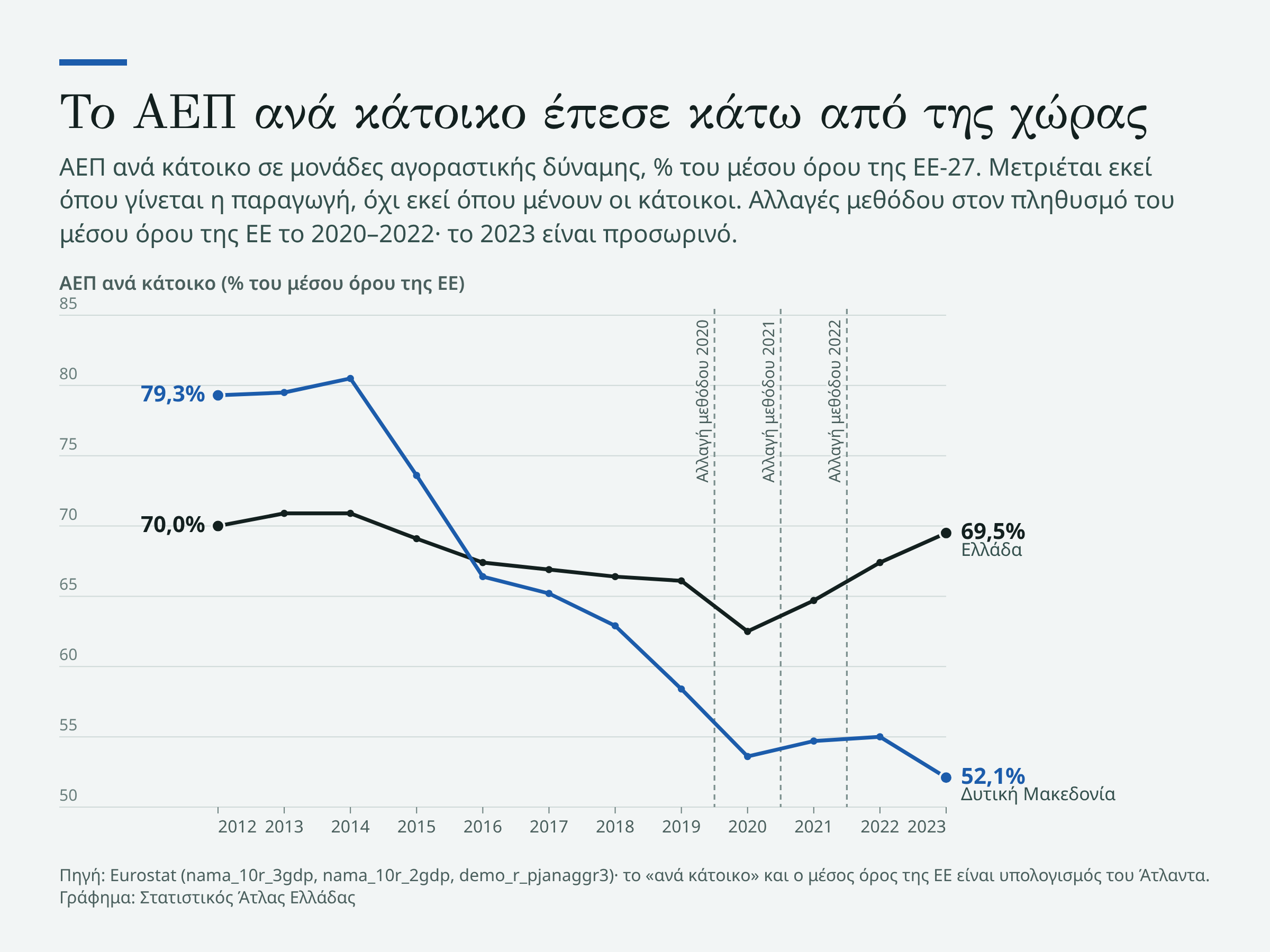
One caveat counts: the EU average, in purchasing power standards per inhabitant, rose 47.7% from 2012 to 2023, by our own calculation from the Eurostat table. With Eurostat’s ready-made index, which gives a fall of about 29 points, about 5 correspond to the decrease in the region’s own GDP per capita and about 24 to the rise of the EU average, by our own calculation. This is why the comparison with the country is cleaner: the country almost followed the EU, the region did not.
The unit Grevena & Kozani was in 2012 fifth among the country’s regional units in GDP per capita and in 2023 thirty-third. Kastoria was already low, at 46.1% of the EU average in 2012. About Kastoria, the Minister of Development Takis Theodorikakos, announcing there on 1 September a new support programme for fur, said that the area «mainly because of the Russo-Ukrainian war, has suffered a very significant blow», as «a huge market has been lost». The export data concern the whole country, not only Kastoria: exports of clothing and articles of fur skin had already fallen from 235 million euros in 2012 to 108 million in 2019, before the war, and were 42 million in 2025; Russia, their largest destination in 2019, has had no recorded value since April 2022, by our own calculation from Eurostat data.
Few give a cause for the fall, and with caution. IOBE writes that Western Macedonia was the only region with a fall in gross value added at current prices in 2020–2024, a development that «is also linked to the ongoing structural adjustment of the local economy (lignite phase-out)». A study of the European programme CINTRAN gives two main causes for the fall in regional GDP since 2010, the economic crisis and the decline in lignite production.
The lignite units were closing gradually: the first two units of Kardia in 2019 and Amyntaio in 2020. At Agios Dimitrios the decommissioning of units I and II was completed in September 2024, according to PPC’s annual report. Units III to V stopped in May 2026, energymag writes.
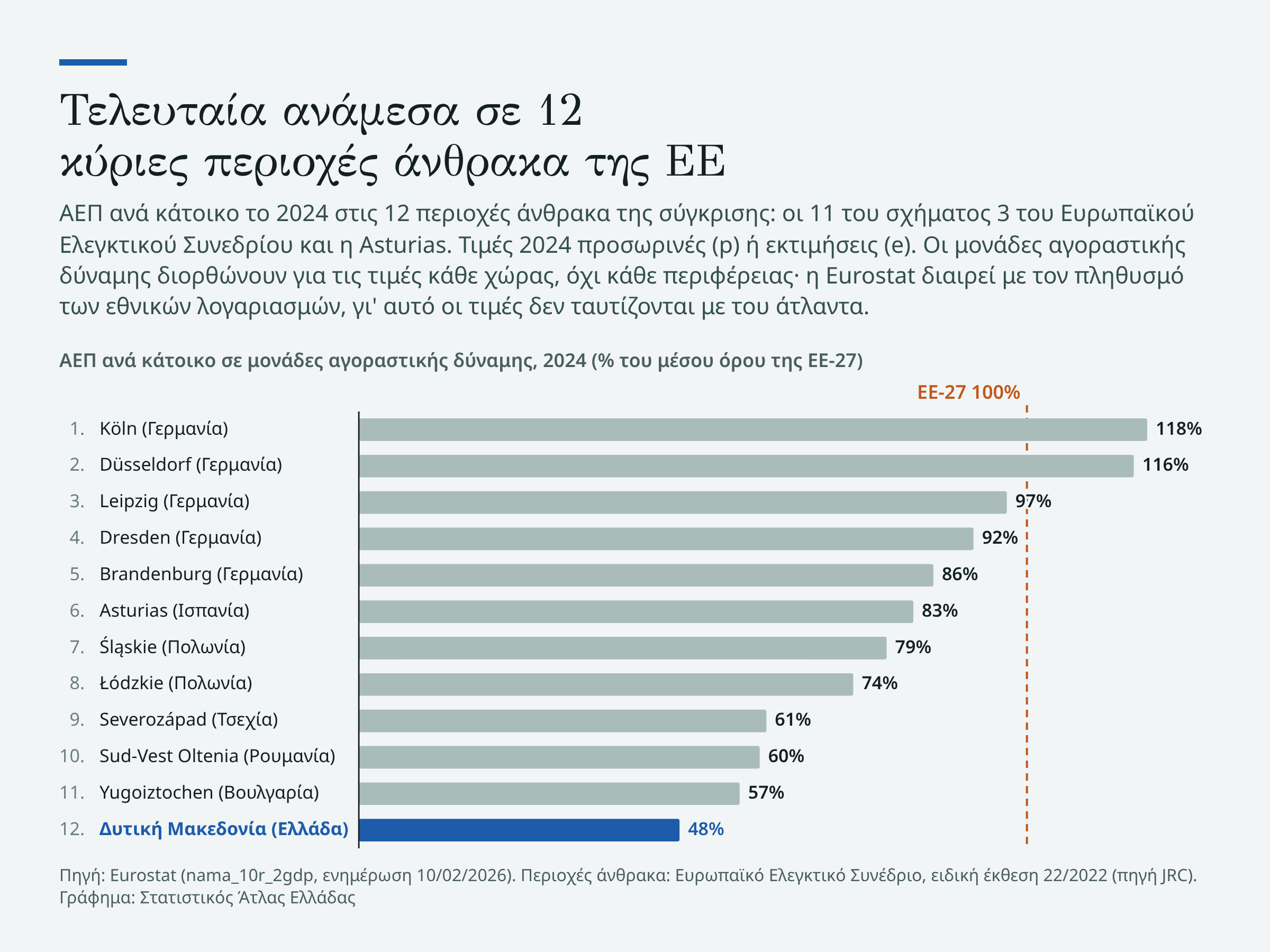
Eurostat ranks Western Macedonia among the five EU regions with a double-digit fall in GDP in volume, that is, without the rise in prices, from 2019 to 2024, without giving a cause for it. From the Eurostat table we calculate a fall of 18.0%, the second largest after Yugoiztochen in Bulgaria. In 2024, with Eurostat’s ready-made index, GDP per capita was 48% of the EU average, the lowest of the 12 coal regions we examined.
The income that stayed
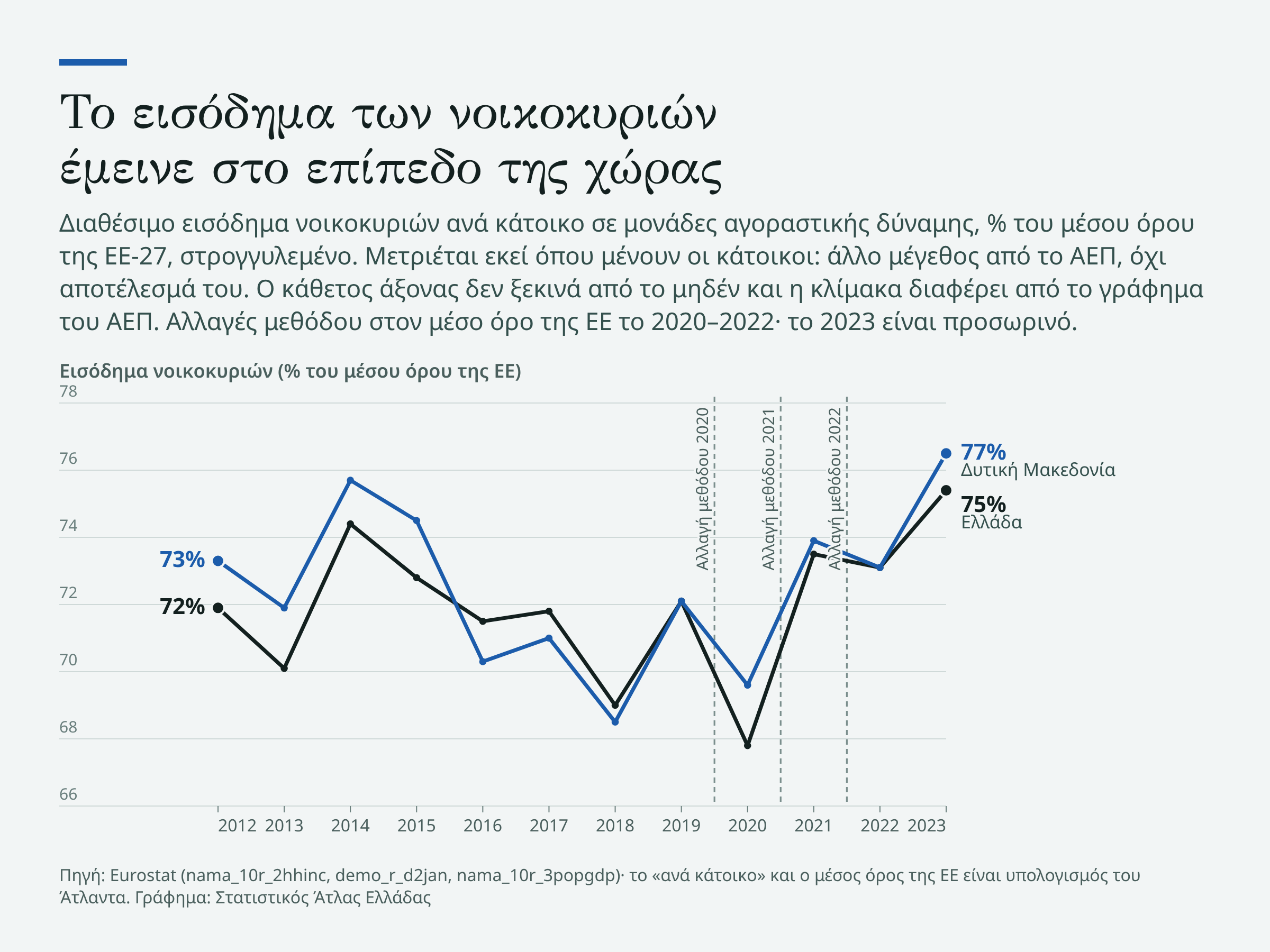
In the same period residents’ income went elsewhere. Household disposable income per inhabitant, in purchasing power standards, was in 2012 at 73.3% of its own EU average and in 2023 at 76.5%, according to provisional data. It was at about the same level as the country in both 2012 and 2019, and in 2023 it was fourth of the 13 regions. Indicatively, because the comparison passes through changes of method, from 2012 to 2023 the region’s GDP per capita fell 27.2 points as a share of the EU average, while income rose 3.2 points as a share of its own: in no other of the 13 regions did the two relative positions move apart so far.
That income has a higher relative position than GDP is not unique: in 2023 this held in 12 of the 13 regions, with the sole exception of Attica (82.8% against 93.2%).
What is unique is the speed of the change, and Eurostat sees it too: in the 2026 regional yearbook it writes that in Western Macedonia GDP per capita at current euro prices hardly changed from 2019 to 2023 (+2.0%), while net disposable income per inhabitant rose 23.4%. This is, according to Eurostat, the fastest rise of income relative to GDP in the whole EU; and the +2.0% is a different measure from the fall in volume, which removes the rise in prices. It gives no cause for Western Macedonia, only the general rules: GDP is recorded where it is produced and income where people live.
The average, however, does not show how income is distributed. Another measure, the share of residents at risk of poverty or social exclusion, was in 2025 29.5% in Western Macedonia and 27.5% in the country. The regional value, however, was 36.3% a year earlier, and it is a sample estimate: for 2024 ELSTAT gives a 95% confidence interval from 28.2% to 44.4%, and for 2025 we did not find a published error.
First place in unemployment is not new
In 2025 unemployment in Western Macedonia was 15.3%, the highest of the 13 regions, when in the country it was 8.9%. It was not new: the region had the highest unemployment in the country in 2021, 2022 and 2023 as well, and only in 2024 was it third, with 12.5%. Since 2021 the region’s unemployment fell by 4.5 points, less than the country’s, so the gap grew. Eurostat names Western Macedonia among the EU regions with the highest unemployment rates in 2025, and in the 11 other coal regions of our comparison unemployment was at most 2.0 points from their country’s average.
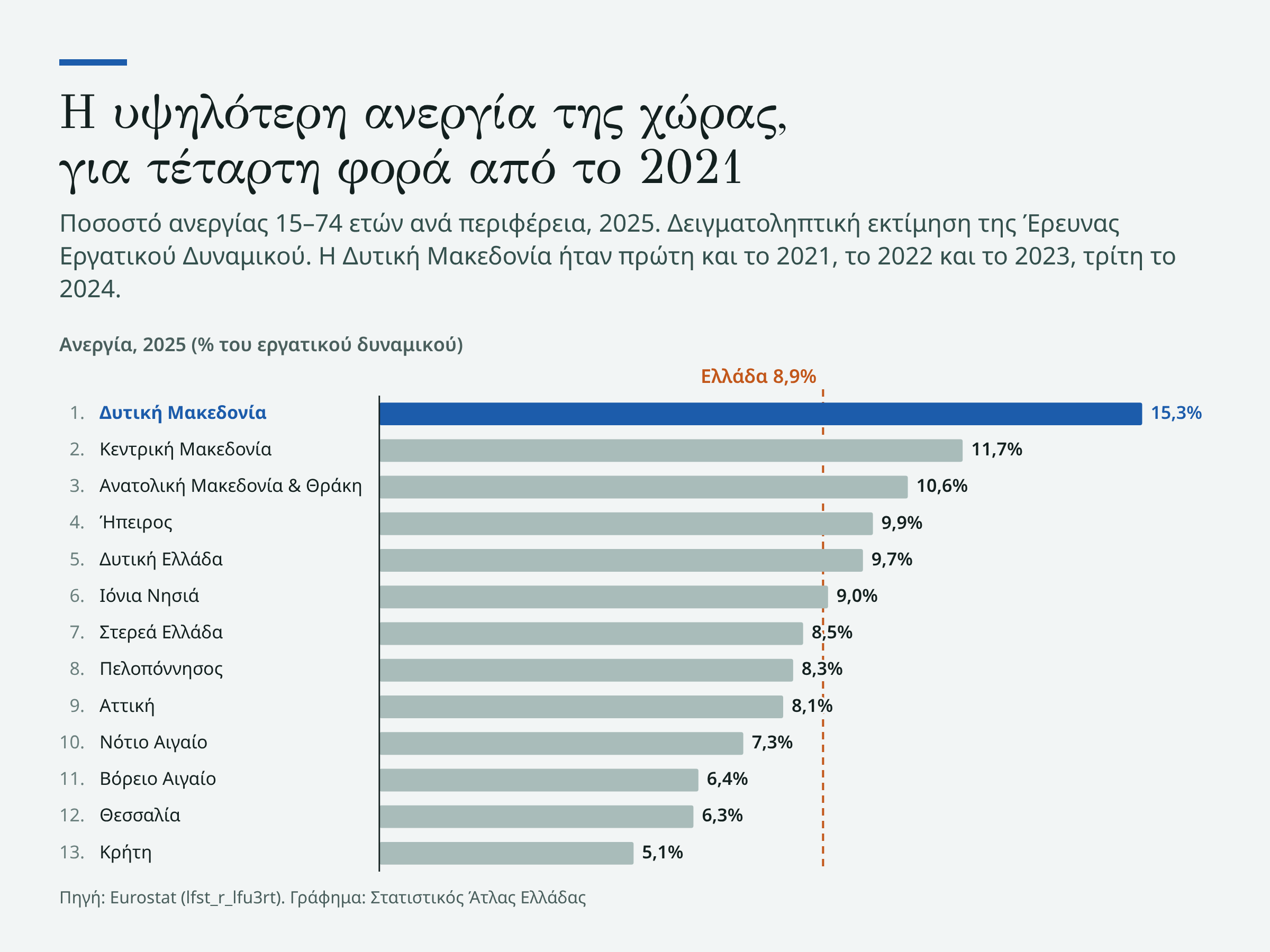
We do not read the jump from 12.5% in 2024 to 15.3% in 2025 as a trend. Unemployment is measured with a household sample, and Eurostat writes that small changes from period to period may be within the margin of error. ELSTAT’s quarterly release does not give an error by region. The Minister of Labour Niki Kerameus stated in March 2025 that the region’s unemployment fell «from 23.8% to 11.1%» from 2019 to the end of 2024; a large fall is also shown by Eurostat’s annual values, but the comparison passes through the break in the series in 2021, after which the results are not fully comparable with the older ones, according to Eurostat.
An argument that the ENA Institute puts forward for the whole country is that unemployment falls also because the population shrinks and young people leave. For Western Macedonia the data do not show this clearly: from 2022 to 2025 the unemployed decreased while the employed increased, and the labour force rose from 108.0 to 110.2 thousand people, although since 2021 it had shrunk slightly; these are Eurostat sample estimates, and the sums are our own.
The other side is employment. In 2025, 61.6% of residents aged 20 to 64 were working, the lowest share of the 13 regions, when in the country it was 71.0%; this too is a sample estimate.
And the work has a different shape. In 2023 only 26.4% of the employed worked in trade, transport, accommodation and food service, the lowest share of the 13 regions, when in the country it was 36.6%, according to provisional data.
How many jobs were lost is told by sources, not by statistics. PPC employed about 5,500 people in the area in 2010 and today about 1,250, Bloomberg writes. About 650 of the 1,500 shops in Kozani have closed, the president of the Trade Association Athanasios Dragatsikas told Bloomberg. «The worst thing you can do to people is to make them feel despair», he added, as translated by SKAI.
They live longer, with few doctors and few visitors
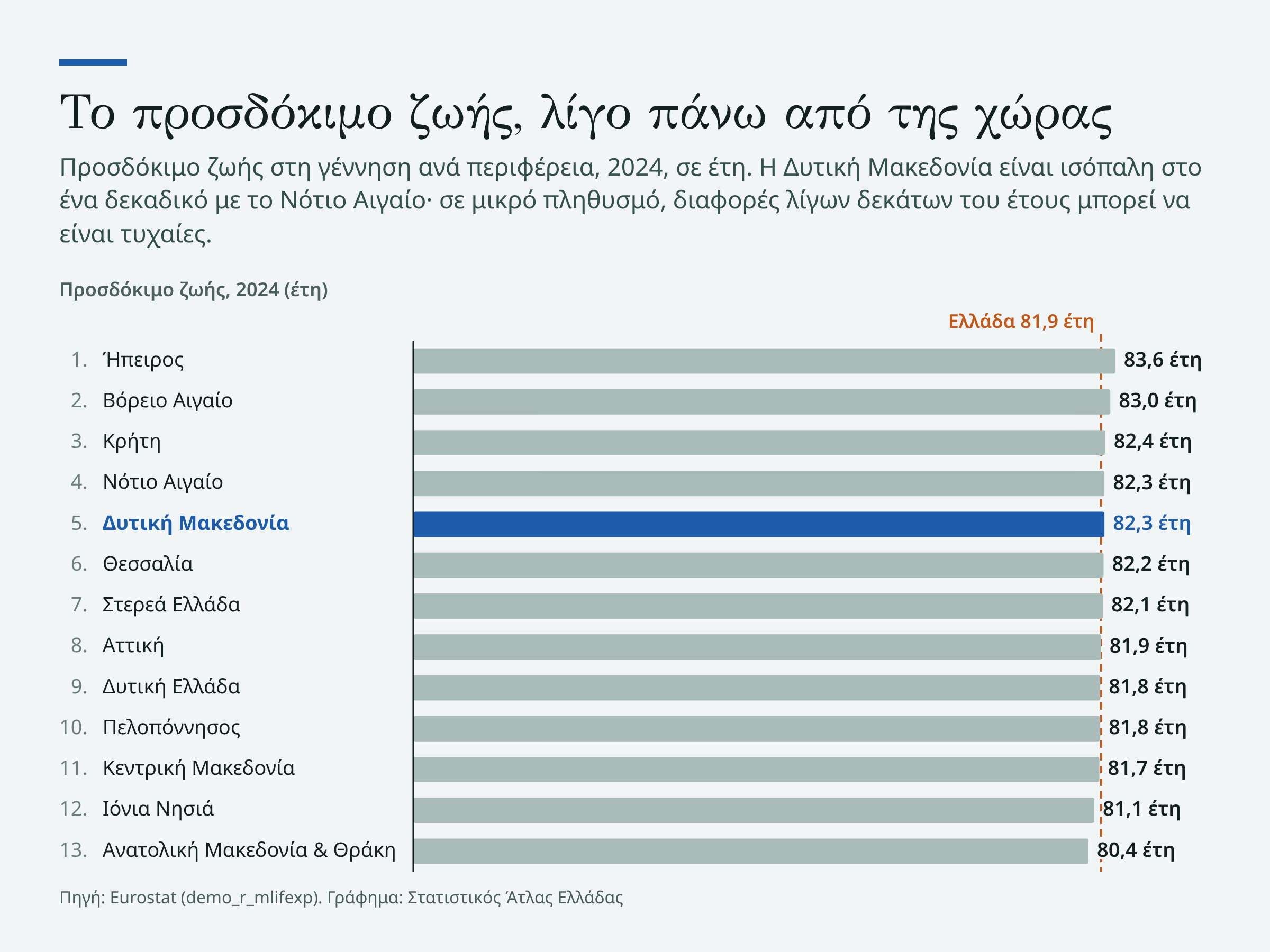
In 2024 life expectancy at birth was 82.3 years in Western Macedonia and 81.9 in the country. Since 2022 it has been slightly above the country every year, fifth of the 13 regions in 2022 and 2023 and tied to one decimal with the South Aegean in 2024. In a region of a few hundred thousand residents such a difference may be due to chance, and no source we found explains why it exists.
Doctors, however, are few. In 2024 the region had 381 licensed doctors per 100,000 residents, eleventh of the 13, when the country had 674. The ratio rose by 3 from 2021 only because the population fell more; in absolute numbers doctors became fewer, by our own calculation.
In May 2026 the Ministry of Health approved the announcement of 36 specialist doctor posts in the region’s five hospitals. In June another 10 followed in Health Centres. In October the 3rd Health Region continued to post ranking lists by specialty, and by 24 October we had not found published how many posts were filled. The hospital of Florina had announced in March 2025 that for the post of permanent paediatrician, advertised in October 2024, «there was no corresponding interest from doctors».
Tourism is growing, from a low base. Overnight stays in the region’s accommodation rose 31.5% from 2022, a post-pandemic recovery year, to 2025, more than the country’s. The region remains last of the 13, however, with 1.5 overnight stays per resident in 2025, against 15.1 in the country. INSETE describes it as an «undeveloped tourist destination», mainly because of connectivity and because it has no sea.
The promise: a memorandum with no number of jobs
What has been signed is a memorandum, which PPC describes as binding, but the project and all commercial terms depend on final agreements, due diligence, grid connection and approvals from the authorities. It provides initially for 300 MW; the expansion to 1 GW the two companies intend only to explore, if they agree and the market allows it. The announcement of the memorandum states neither an amount nor jobs.
The 5.8 billion euros that Bloomberg wrote concern PPC’s whole plan for the area, not only the data centre. PPC had announced the plan in April 2025, with 5.75 billion euros, of which 2.3 for the data centre.
For jobs, numbers circulate with different definitions:
- Up to 2,000 new jobs in the operation of all projects, according to PPC’s release of April 2025.
- At least 2,200 permanent jobs from all projects, of which 1,500 at the data centre when it reaches 1 GW, according to Alexandros Soumelidis, who oversees PPC’s development projects in the area, to Bloomberg on 17 September.
- About 400 to 500 workers when the first 300 MW phase operates, according to Deputy Prime Minister Kostis Hatzidakis on 23 September.
- About 1,000 permanent jobs for every 1 GW of data centre in Greece, according to a PwC study for the government, as reported by ProtoThema on 7 August.
- About 50 permanent workers per facility, according to an estimate by the open initiative «To Revma», which states that it is not a party faction, from AWS data centres in other countries.
Soumelidis also gave Bloomberg PPC’s argument: «The multipliers in the economy from the creation of a data centre are very large», in our own translation. Hatzidakis spoke of «a very large project not only for Western Macedonia but for the whole of Greece».
In a Brookings study for the US, in August, Dany Bahar and Greg Wright estimate that a typical county that gained its first large data centre gained about 100 to 200 jobs: local jobs are created, they write, «though fewer than industry advocates claim».
The area has heard promises before. A battery factory with more than 2,000 permanent jobs was abandoned in late 2024 and a green hydrogen plan with 18,000 direct jobs did not go ahead, Canary Media wrote in December 2025. Other projects were done: PPC’s photovoltaics, 2,130 MW on former lignite land in Amyntaio and Ptolemaida, were completed in construction terms, as PPC announced on 6 April 2026.
The Just Transition is moving more slowly than the average: in August 2026 the Greek programme of the Just Transition Fund, for all its areas, had declared expenditure of 11.6% of its budget, when in the 27 states it was 18.0%, but it was ahead of Germany, Romania and Spain, according to Commission data. Its expenditure can be made until the end of 2029. The organisations Bankwatch and Forum Energii, which analysed six countries, wrote in April that the slowness is due to structural and timing constraints and not to a lack of need. Hatzidakis said on 23 September that in the region 670 investment plans are being implemented with grants from the Fund and the development law, «with an estimated creation of 3,700 jobs»; it is a forecast, not a measurement.
On water, PPC estimates that the data centre will need up to 400,000 cubic metres a year, «just 0.6%» of the water required by lignite activity. The 0.6% comes out on the basis of the 70 million cubic metres licensed for all the plants of the basin; on the basis of the 30 million of Agios Dimitrios it is 1.3%, by our own calculation. «To Revma» notes that this estimate is not a condition of the permit and that the environmental permit is pending.
The tax bill with the Thessaloniki International Fair measures, which was put to public consultation until 1 November, extends from 2027 the exemption of the main residence from ENFIA (for value up to 400,000 euros) to settlements of up to 2,200 residents in Western Macedonia and up to 2,000 in the rest of the country, outside Attica; the current limits are 1,700 and 1,500.
The deputy regional governor Anastasios Rafailidis wrote on 18 September that «the presence of one of the largest international technology groups in such a project is in itself significant». The Kozani MP of PASOK Paris Koukoulopoulos asked on 30 September in Parliament for four returns to the community, among them cheap electricity and priority for locals, and said: «We know that in permanent operation the jobs are neither thousands nor all of specialised knowledge, as the Prime Minister said, on the contrary a significant part is low-skilled and not well paid.» On 21 October, again in Parliament, he proposed that two lignite units be restarted outside the Energy Exchange and, if the data centre prevents it, that another site be considered for it, such as the Kardia power plant, provided the local community agrees.
The Kozani Prefectural Committee of SYRIZA argued on 2 October that permanent jobs in such facilities rarely exceed 30 to 50 per unit. On 6 October the party’s secretary Nikos Pappas asked in Kozani for clarifications on the data centre’s needs for energy and water and on the jobs. The associate professor of the University of Western Macedonia Lefteris Topaloglou asked on 17 October: «How much of the value this investment will create will remain in Western Macedonia?»
The union SEEEN held a three-hour work stoppage at Ptolemaida V on 30 September, demanding that lignite operation continue. On 22 October the trade union faction DAKE Spartakos asked for an extension of the unit’s operation by official decision. Kozani’s district heating is running this year on oil, as a transitional solution for two winters. The president of the Kozani DEYA Panagiotis Matiakis wrote on 21 October that «from this year we were obliged, because of the lignite phase-out, to change the way we produce thermal energy».
«To Revma» proposes a Local Benefit Pact with measurable targets, which is a proposal and not a condition of the investment. The invitation to the Regional Council meeting of 29 October, on PPC’s investment planning in the area, designated the regional governor Georgios Amanatidis as rapporteur and listed the participation of four PPC executives, among them Soumelidis.
What we do not know
We do not know why household income held while GDP fell: Eurostat records it but does not explain it, and we found no other source. We do not know how many young people left and where they went; ELSTAT will publish the 2025 migration flows on 18 December.
We do not know how many permanent jobs the data centre itself will have and how many will go to locals, nor have we seen an environmental impact study. For the investments financed by the Just Transition Fund and the Development Law, Hatzidakis said that there is an estimate of 3,700 jobs, but we did not find a count of those created; Bankwatch and Forum Energii wrote in April that for Greece progress data on spending by area are not published. And we do not know whether Ptolemaida V will burn lignite in the winter of 2027.
Kostis Hatzidakis invited everyone in July to come back on 31 December to check what the government has planned. The first 300 MW, Bloomberg writes, are targeted for completion by the end of 2028. Until then, the numbers in this article are a point from which the promise can be measured.
How we measured it
The numbers for Greece are from the Statistical Atlas of Greece, from ELSTAT and Eurostat tables, each with its own year. The atlas’s GDP per capita divides Eurostat’s GDP by the population of the demographic statistics, while Eurostat divides by the population of the national accounts, which according to Eurostat does not coincide with the demographic one. We use Eurostat’s ready-made index in comparisons with other countries, and purchasing power standards correct for the price level of each country, not of each region. The EU average, in GDP and in income, is affected by changes of method in the population of Poland and Slovakia in the years 2020–2022, so the 2012–2023 comparisons are indicative, and the 2023 data are provisional.
Unemployment has a change of method in 2021 and we compare it only from then. The indicator «at risk of poverty or social exclusion» is a sample estimate; the income criterion concerns the year before the survey (in the 2025 survey, 2024 income). In Greece doctors are those with a licence to practise, excluding retirees and those working abroad, while Eurostat prefers to count those practising medicine; this is why we do not compare them internationally. Overnight stays concern hotels, rented rooms and campsites, excluding short-term letting, and we compare them from 2022, because in 2020 ELSTAT changed the method for rented rooms and the years 2020–2021 were affected by the pandemic.
The 12 coal regions of the comparison are the main ones in figure 3 of the European Court of Auditors, sourced from the Commission’s Joint Research Centre, together with Asturias, which the same text mentions. In international comparisons we use Eurostat tables and, for the Just Transition Fund, Commission data. We read Bloomberg in Greek translations and in an English republication.
Sources: Eurostat, ELSTAT, PPC, European Commission, European Court of Auditors, IOBE, INSETE, Brookings Institution, Bankwatch, Region of Western Macedonia.