


The gender employment gap fell in 2025 to its lowest point since 2013, but Greece remains third in the EU. What Eurostat and ELSTAT show, and what they do not.
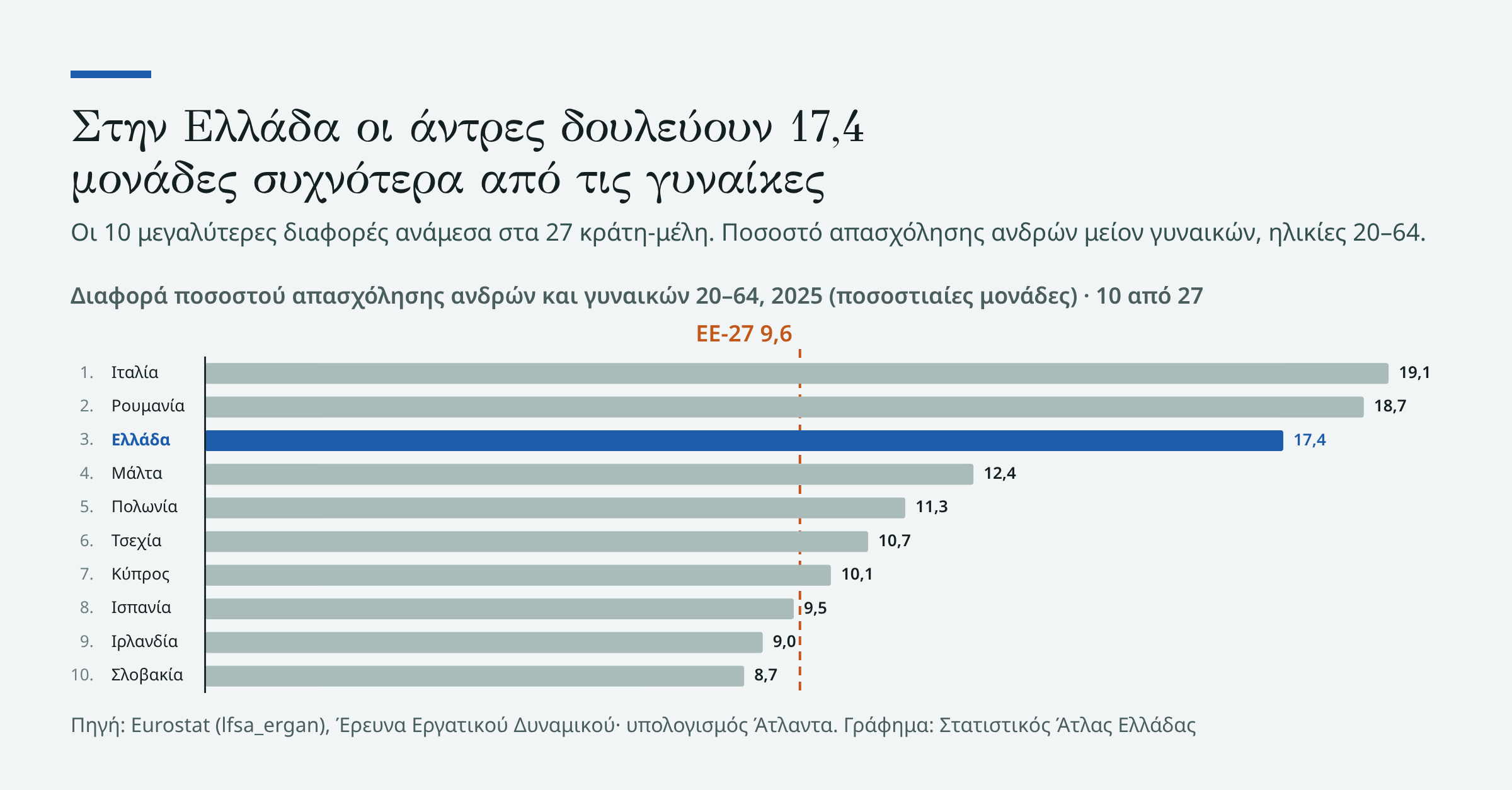
In 2025, 62.3% of women aged 20–64 in Greece were in work, against 79.7% of men. The gap is 17.4 percentage points, the third largest in the EU-27, after Italy (19.1) and Romania (18.7), as Eurostat also records. In the EU the corresponding rates were 71.3% and 80.9%, a gap of 9.6 points. Greece also has the third lowest employment rate for women, above Italy (58.0%) and Romania (59.5%).
Since 2013, women have gained 19 points
In 2013, 43.3% of Greek women aged 20–64 were in work. In 2025 it was 62.3%, a rise of 19.0 points. Men rose from 62.7% to 79.7%, or 17.0 points. So the gap narrowed from 19.4 to 17.4 points. In the EU it narrowed from 11.8 to 9.6. The distance between Greek women and the average for women in the EU fell from 18.2 points to 9.0, because the EU rate rose from 61.5% to 71.3%.
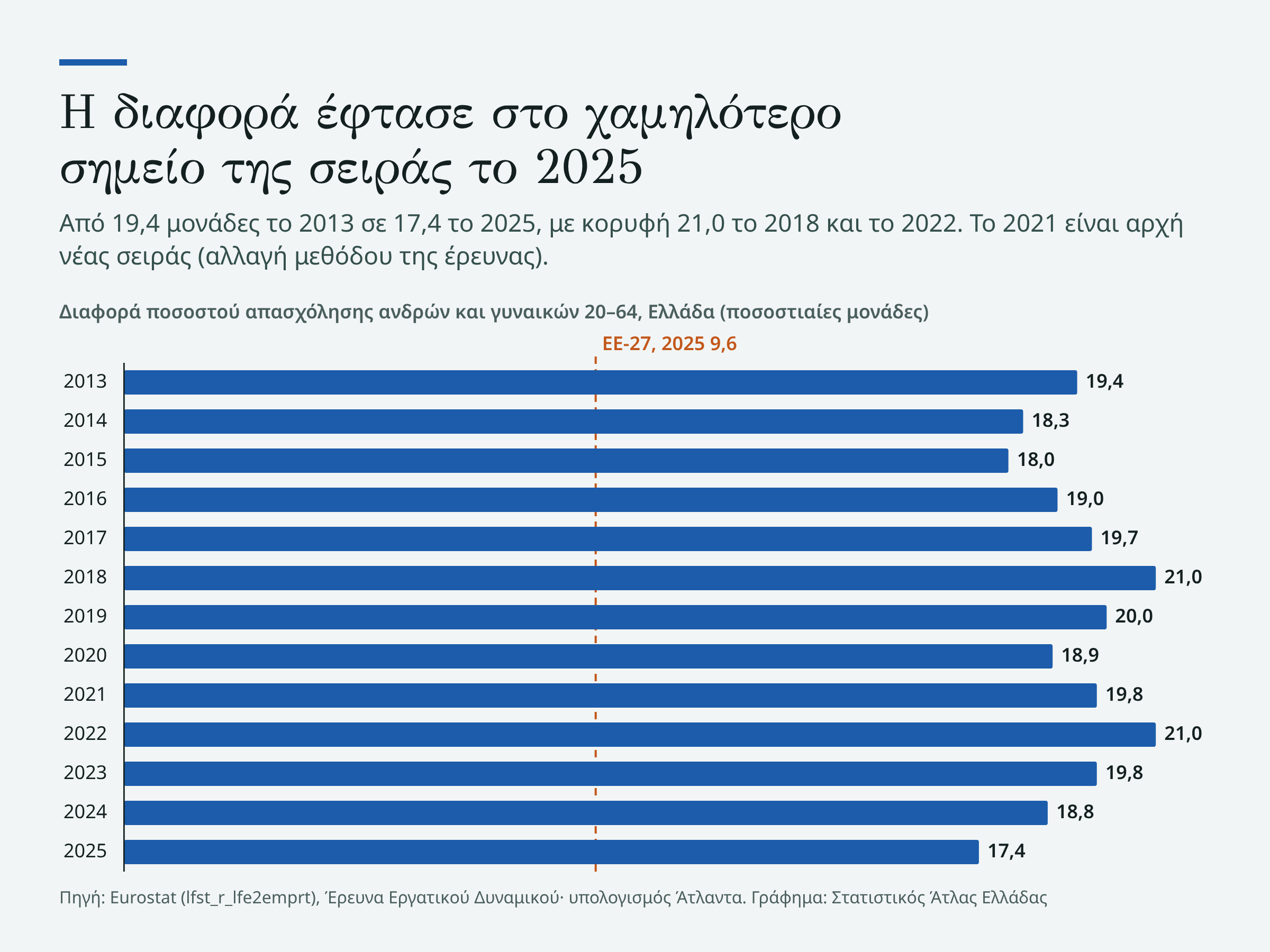
The path was not a straight line. The gap reached 21.0 points in 2018 and again in 2022, and has narrowed three years in a row since. But there is also a break. Since January 2021 ELSTAT has applied a new European regulation: data are collected with an electronic questionnaire, the definition of people temporarily absent from work changed, and so did the weighting, as it describes in its quality report. Eurostat flags 2021 with «b», as the start of a new series. So we do not read 2020–2021 as a change, and compare only within each series: 19.4 to 18.9 up to 2020, 19.8 to 17.4 from 2021.
Thirteen regions, none below the EU average gap

The smallest gap in 2025 was in Attica, 11.9 points, and in Epirus, 12.1. The largest was in Central Greece (Sterea Ellada), 29.0, with 86.9% of men and 57.9% of women in work. Western Greece (24.8) and the South Aegean (24.4) followed. All 13 regions had a gap larger than the EU average of 9.6. The employment rate of women ranged from 50.8% in Western Macedonia to 67.3% in Attica.
Regional values need care, because the Labour Force Survey is a sample survey. We found no published confidence interval for these values. Central Greece had a gap of 22.9 in 2013, so a single year does not show a lasting picture. The order between close regions is not stable.
Part-time work and reasons for inactivity
In 2025, 8.3% of employed women aged 20–64 worked part-time, against 27.5% in the EU. For men the rates were 2.6% and 7.8%. Part-time work, therefore, is not the feature of employed Greek women; the gap concerns whether they have a job.
The survey also asks people outside the labour force who want to work why they are not looking. Among Greek women aged 20–64 in that group, 29.0% cited care of children or of adults with disabilities, against 19.3% in the EU. Another 20.6% said they believe no job is available, against 9.2%. For Greek men the care figure is not published, and their other values carry a low-reliability flag. These are answers from a small group, not an explanation of the gap.
What the official targets say
The EU has a target of 78% employment for ages 20–64 by 2030, under the European Pillar of Social Rights Action Plan. Eurostat notes that the same plan sets a goal to reduce the gender gap. The Council of the EU writes that halving the EU gender employment gap is essential for reaching 78%. We found no Greek national target for the gender gap.
Greece’s national target for 2030 is 71.1%, the lowest in the EU. In 2025 employment for ages 20–64 was 71.0%, 0.1 point short, and 7.0 points below the EU target.
The latest ELSTAT picture, for the second quarter of 2026, shows unemployment of 10.6% among women and 5.7% among men, and the release notes that the highest unemployment rates are among women. It is a different indicator (unemployed as a share of the labour force aged 15+), and one quarter is not a trend.
What we do not know
The data do not explain why the gap is larger in Greece or why it narrowed. The answers on care and part-time work describe, they do not prove a cause. We do not know whether the 2023–2025 narrowing continues, or whether one-point changes are beyond sampling error.
How we measured it
The indicator is the share of residents aged 20–64 who worked at least one hour in the survey week, from ELSTAT’s Labour Force Survey as published by Eurostat. Countries come from table lfsa_ergan and regions from lfst_r_lfe2emprt. The «gap» is the men’s rate minus the women’s rate, in percentage points, calculated by us. The survey covers private households only. For Spain and France the values carry Eurostat’s flag «d» (different definition).
Sources
- Eurostat, lfst_r_lfe2emprt (NUTS 2 regions, 2013–2025), lfsa_ergan (countries), lfsa_epgaed (part-time), lfsa_igar (reasons for inactivity), updated 30 October 2026.
- Eurostat, Employment – annual statistics (Statistics Explained).
- Council of the EU, document 13806/26 ADD 1 (2 October 2026) and 13296/25 ADD 1 (2025): national 2030 employment targets.
- ELSTAT, Labour Force Survey, 2nd quarter 2026 (press release of 4 September 2026) and quality report.

